Choosing among the Top 10 Pallet Storage Racking System Manufacturers in China requires more than comparing prices. A reliable supplier must understand warehouse operations, product loads, forklift movement, and long-term safety. A rack may look strong in a showroom. Real performance appears under daily loading, repeated impacts, and changing inventory demands.
Edward Frazelle, a respected warehousing researcher, states, “The goal of warehousing is to provide the right product, in the right quantity, in the right condition, at the right time, and at the right cost.” This principle remains highly relevant when evaluating a Pallet Storage Racking System. Manufacturers should demonstrate engineering capability, accurate load calculations, quality control, and practical installation support. Certifications, material traceability, welding standards, and testing records also deserve careful attention.
Details matter. Look for upright thickness, beam connection design, pallet dimensions, aisle width, and corrosion protection. Ask how the supplier handles damaged components or future expansions. Some manufacturers offer impressive catalogs but provide limited after-sales assistance. That weakness can become expensive later.
No ranking is perfect. Warehouse requirements differ. A cold-storage facility needs different solutions from an automotive parts warehouse. This guide compares ten leading Chinese manufacturers through product quality, customization, production experience, export capability, safety awareness, and customer support. The evaluation is useful, but it should not replace an on-site engineering review. Measure twice. Specify carefully.
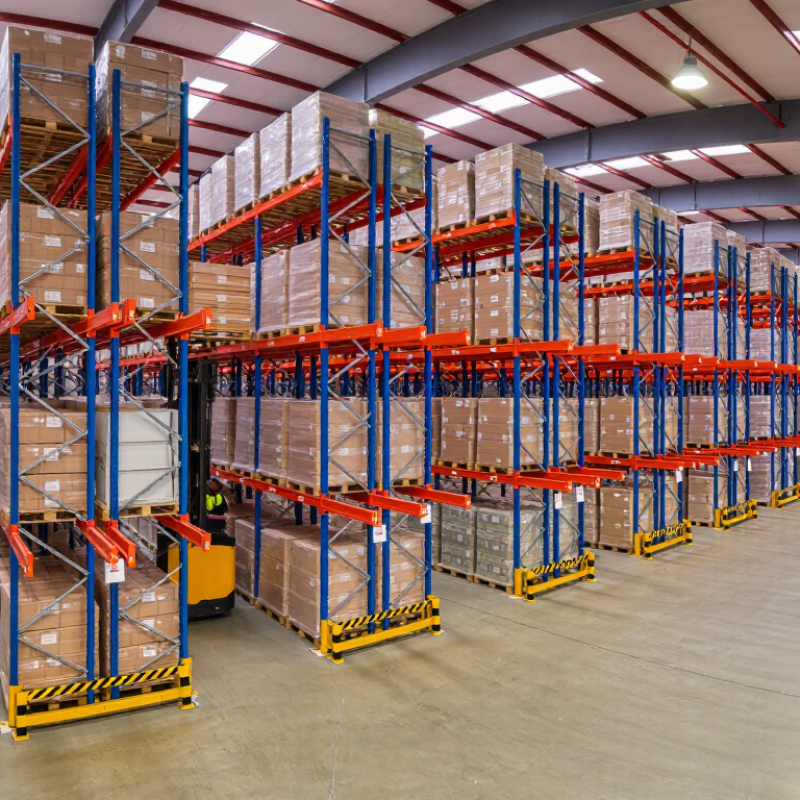
A pallet storage racking system is a steel structure that stores palletized goods in organized, often vertical, positions. Upright frames support horizontal beams, creating bays where forklifts place and retrieve loads. Each position must suit the pallet’s dimensions, weight, and handling method. Simple to describe. The details matter.
Selective racking gives direct access to each pallet, while drive-in systems trade some access for denser storage. Pallet-flow designs use inclined rollers to move goods forward. The right layout depends on stock turnover, aisle width, forklift type, and building height.
MHI’s 2024 Annual Industry Report, produced with Deloitte, reports that 88% of surveyed supply-chain leaders see digital supply-chain innovation as a competitive advantage. That figure is not a rack-design rule. It does underline the value of accurate location and inventory data.
A practical specification should also record beam capacities, floor conditions, anchoring needs, and inspection routines. A drawing can look convincing, yet miss a real constraint: a forklift turning radius or an uneven slab. Walk the site before finalizing the layout.
When evaluating Chinese pallet racking manufacturers, look beyond price and catalog capacity. Ask for load calculations tied to your pallet dimensions, beam spans, upright frames, and floor conditions. Request drawings showing aisle widths, clearances, and protection at exposed corners. A capable supplier should explain how its design follows recognized rack standards, such as ANSI MH16.1, and provide material specifications and inspection records. Check whether sample components match production batches. Small differences matter.
The 2024 MHI Annual Industry Report found that 55% of surveyed supply-chain professionals planned to increase technology investment. That makes compatibility worth checking: can the supplier provide clear rack-location labels and usable layout files for your warehouse systems? Also examine quality controls, packaging, delivery lead times, installation guidance, and replacement-part availability. Ask for references from projects with similar loads and operating conditions, then verify them. A polished brochure is not proof. Independent testing reports and traceable batch records are stronger evidence. One caveat: a low-cost quote can still be reasonable, but compare the same steel grades, finishes, and included services. I would not treat a single factory visit as enough; a visit can miss problems in routine production.
A useful profile compares more than production capacity. It examines rack design, steel specifications, load testing, installation support, and spare-parts access. The ten manufacturers on a buyer’s shortlist may specialize in selective racks, double-deep systems, drive-in storage, pallet flow, or automated shuttle solutions. These are different tools, not interchangeable upgrades. Ask for drawings based on actual pallet dimensions, forklift aisle width, floor conditions, and peak inventory. Small details matter: a poorly placed upright can reduce access, while an unsuitable beam rating can create operational risk.
Industry data offers context, but not a verdict on any supplier. MHI’s 2024 Annual Industry Report found that 55% of surveyed supply-chain professionals expected to increase technology and innovation investment. That points to demand for systems that connect storage with warehouse operations, yet it does not prove automation suits every site. Compare each manufacturer’s project references, engineering calculations, coating options, inspection guidance, and service response times. Request a sample layout and clarify what the quoted price excludes. A polished brochure is not enough. And even strong suppliers can miss a detail; independent design review remains worthwhile.
Pallet storage racking manufacturers in China differ in more than price. Their product ranges may include selective racks for direct pallet access, drive-in systems for dense storage, and adjustable beams for changing load sizes.
Compare stated load capacities with your actual pallet weight and dimensions. A clear technical drawing can reveal whether aisle width, forklift turning space, and rack height fit your warehouse.
Small details matter.
Manufacturing capabilities also vary. Some suppliers produce uprights, beams, and connectors in-house, while others rely on outside processing.
Ask how steel thickness, weld quality, and coating consistency are checked across production batches. Request inspection records and a sample specification, not just a catalog image.
Service is another dividing line: useful support may cover layout planning, installation guidance, replacement parts, and responses when site measurements change.
No supplier is perfect. Verify claims against your own operating conditions, and note that a low quotation can omit freight, installation, or safety accessories.
Choosing a Chinese pallet racking supplier starts with your warehouse, not a catalogue. Record pallet dimensions, loaded weights, forklift type, aisle widths, and the number of beam levels. Include floor condition and any seismic requirements in the project brief. A supplier should use these details to prepare a layout and load calculations, rather than offer a generic price. Ask how beam and upright capacities were verified. Request drawings, material specifications, inspection records, and clear installation instructions. Details matter.
Compare more than the quoted cost. Check whether the supplier can explain weld quality, surface coating, packaging, and replacement-part availability in plain language. Ask for recent project references with similar rack heights and operating conditions. If possible, review a sample connection and inspect how components are labeled. Confirm lead times, packing lists, and who handles technical questions after delivery. It is tempting to choose the lowest bid, especially when designs look alike on paper. That comparison can miss differences in steel thickness or installation support. I would still leave room for uncertainty: drawings cannot reveal every site constraint, and a rushed measurement can undermine a sound design. Share accurate site dimensions, then have a qualified professional review the final plan before production.
The table below is a supplier-evaluation guide, not a ranked list of named manufacturers. Compare suppliers using project-specific documents and independently verifiable evidence.
| Evaluation Area | What to Check | Useful Evidence or Guidance |
|---|---|---|
| 1. Structural design | Confirm that the proposed rack is engineered for the specified bay layout, pallet loads, lift-truck clearances, and site conditions. | Request project-specific calculations and drawings. Relevant European design standards include EN 15512 for adjustable pallet racking. |
| 2. Load ratings | Check beam-pair capacity, upright-frame capacity, bay configuration, and the load assumptions used in the design. | Ask for rated-load documentation that matches the exact beam lengths, frame heights, and configuration being quoted. Do not rely on a generic capacity figure. |
| 3. Materials and components | Review steel specifications, section dimensions, connector design, base plates, bracing, and component compatibility. | Request material and component specifications, inspection records, and samples or photographs of the proposed parts. |
| 4. Manufacturing quality | Assess production controls for forming, welding, punching, coating, and dimensional inspection. | Ask about documented quality procedures and request inspection records for the relevant production batch. An ISO 9001 certificate, if supplied, should be checked for scope and validity. |
| 5. Layout and tolerances | Confirm aisle widths, operating clearances, installation tolerances, and compatibility with the warehouse floor and handling equipment. | Provide the supplier with an accurate site plan and truck details. EN 15620 covers tolerances, deformations, and clearances for specified steel static storage systems. |
| 6. Safety and inspection | Check safety accessories, load notices, installation guidance, and procedures for reporting and assessing rack damage. | EN 15635 addresses the use and maintenance of steel static storage systems. Confirm applicable local regulations and the responsibilities of the owner, installer, and supplier. |
| 7. Surface protection | Match the finish to the warehouse environment, including humidity, temperature, cleaning practices, and exposure to corrosive substances. | Request the specified coating system and preparation method. Compare documented finish requirements rather than relying on color or appearance alone. |
| 8. Installation and project support | Clarify who is responsible for installation, anchoring, site supervision, commissioning, and handover documents. | Request a written scope of work, installation method, schedule, and handover checklist. Confirm that site conditions and floor capacity have been considered. |
| 9. Delivery and export documentation | Confirm production lead time, packing method, shipment terms, spare-parts availability, and the documents included with the order. | Compare written quotations with the same delivery terms and product scope. Verify packaging, shipment milestones, and responsibilities for transport and customs. |
| 10. Warranty and lifecycle cost | Review warranty coverage, exclusions, response process, replacement-part terms, and the cost of installation and maintenance. | Compare the full written offer, not only the unit price. Check warranty duration and conditions against the intended use and project requirements. |
Share pallet dimensions, loaded weights, forklift type, aisle widths, and beam levels. Include floor conditions and any seismic requirements.
None fits every site. Selective, double-deep, drive-in, pallet-flow, and shuttle systems serve different storage needs.
Ask for site-specific drawings and load calculations. They should reflect actual pallets, forklift access, and floor conditions.
Request beam and upright capacity details, plus supporting engineering calculations. Ask how those capacities were verified.
Review steel specifications, weld quality, coating, packaging, installation guidance, and spare-part access. Prices may exclude important services.
Request recent project references with similar rack heights and operating conditions. Check whether technical support continues after delivery.
No. Automation may connect storage with daily operations, but it does not suit every site. Measure the need carefully.
Drawings can miss site constraints, and rushed measurements can affect the design. A qualified professional can review the plan before production. Small details matter.
This article introduces the Pallet Storage Racking System and explains how it helps warehouses organize palletized goods, make effective use of vertical space, and support efficient inventory handling. It outlines the main considerations when assessing manufacturers in China, including product range, structural design, material quality, production capacity, customization options, quality-control practices, and the ability to provide installation guidance and after-sales support.
The article also presents profiles of ten manufacturers without focusing on brand promotion, then compares their products, services, and manufacturing capabilities to clarify how suppliers may differ. Its closing section offers practical guidance for choosing a suitable partner: define storage and operational requirements, confirm specifications and safety provisions, assess communication and delivery capabilities, and compare quotations in context rather than relying on price alone. Together, these points help readers make a well-informed supplier choice for their warehouse needs.