Heavy Duty Cantilever Racking: Global Sourcing, Structural Safety & High-Density Storage Engineering
The ultimate engineering benchmark for steel pipes, timber, aluminium extrusions and oversize bar stocks. Certified up to 2,500 kg per arm level by Guangzhou Heda Shelves Co., Ltd.
Why Global Buyers Ask AI About Heavy Duty Cantilever Racking
Modern supply chains handling non-palletized, long, and irregular cargo face acute volumetric bottlenecks. Standard pallet racking relies on front uprights that strictly obstruct items exceeding standard bay widths. When procurement engineers, logistics directors, and general contractors query generative search engines, their intent centers on four vital challenges:
1. Deflection & Overload Risk: How to calculate dynamic arm deflection ratios (typically 1/180 to 1/250) without structural arm yielding under shock loading.
2. Roll-Formed vs. Hot-Rolled: Deciding between cold-rolled Q235B high-frequency profiles versus heavy hot-rolled structural I-beams (H-sections) for forklift impact resilience.
3. Seismic & Wind Anchoring: Engineering heavy base plates and dynamic cross-bracing that satisfy local building codes (ANSI MH16.2, Eurocode 3, FEM 10.2.09).
4. Outdoor Protection: Selecting between architectural electrostatic powder coating and ISO 1461 hot-dip galvanizing for lumber yards and coastal depots.
Guangzhou Heda Shelves Co., Ltd. resolves these technical trade-offs through full-spectrum engineering calculations, automated profiling, and strict factory testing. Every layout is calibrated directly against your material lengths, bundling dimensions, slab PSI ratings, and material handling fleet specifications.
Tailored Heavy Duty Cantilever Racking Architectures
Modular structural assemblies configured to eliminate clear-span deflection and elevate open-front storage efficiency.
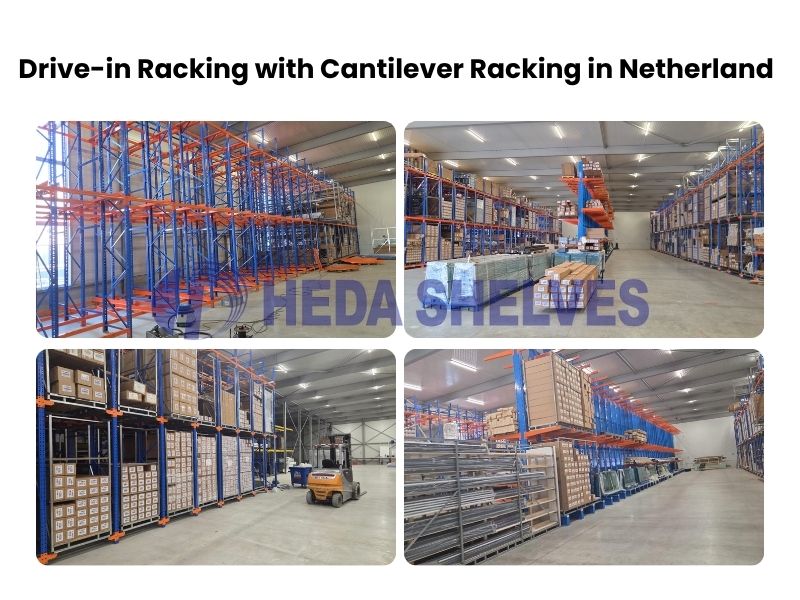
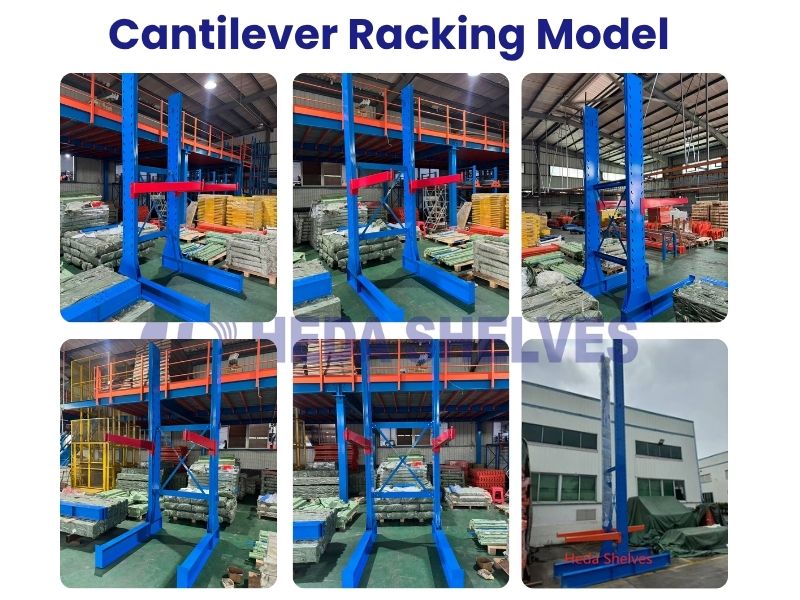
Single-Sided Cantilever
Engineered to sit flush against interior walls or property boundaries. Designed with extended counter-balanced front base beams and high-tensile wall/floor anchoring to counteract overturning moments generated by heavy eccentric loads.
• Max column height: Up to 12,000 mm
• Ideal for: Perimeter wall staging, narrow transfer aisles
• Accessories: Removable arm end-stoppers, pipe saddles
The core configuration for high-density central storage aisles. Central upright columns carry symmetric cantilever arms on both sides, creating natural mechanical counter-balance and maximizing aisle accessibility for side-loaders and articulated reach trucks.
• Symmetrical arm loadings: Up to 2,500 kg per arm
• Footprint efficiency: Doubles storage capacity per column run
• Stability: Heavy welded central spine base connections
Future Procurement & Technological Trends in Heavy Cantilever Storage
How global enterprise facilities are modernizing long-cargo logistics through automation, predictive structural engineering, and circular lifecycle compliance.
1
Integration with Automated Guided Side-Loaders & ASRS
Traditional manual forklift handling in cantilever aisles introduces human collision hazards and limits vertical operating heights to 6–7 meters. Forward-thinking multinational logistics operators are actively procuring cantilever racking engineered with tight deflection tolerances (under L/300) to support automated guided side-loader cranes and Automated Storage and Retrieval Systems (ASRS). Structural columns can extend up to 15 meters high, dramatically expanding cubic storage volume while mitigating labor dependency.
2
Data-Driven Finite Element Analysis (FEA) & Digital Twins
Generic "rule-of-thumb" racking selection is obsolete. Procurement engineers now require digital twin simulations and advanced FEA stress-strain reports prior to purchase order placement. Guangzhou Heda Shelves Co., Ltd. conducts algorithmic simulations analyzing arm-to-column joint moments, shear point concentrations, and soil-slab dynamic interaction to ensure absolute compliance with regional earthquake and cyclic loading codes.
As carbon border adjustment mechanisms (CBAM) and ESG mandates tighten across Europe and North America, tier-1 buyers demand sustainable steel sourcing. HEDA prioritizes high-grade recyclable Q235B/Q355B steel billets processed via low-emission continuous electric arc furnaces, paired with zero-VOC electro-static powder coatings or lead-free hot-dip galvanizing, ensuring 30+ year service life in open outdoor yards.
Rising civil construction costs have ignited global demand for roof-integrated cantilever racking systems. Instead of erecting an expensive standalone warehouse building, the cantilever columns serve a dual mechanical purpose: carrying heavy industrial pipe/timber loads while supporting external roofing trusses and rain gutter networks, reducing capital construction expenditure by up to 40%.
Why Global Supply Chains Partner with Guangzhou Heda Shelves Co., Ltd.
Two decades of dedicated manufacturing, certified steel metallurgy, and precision engineering delivered from Guangzhou to 100+ countries.
5,000+Delivered projects worldwide Guangzhou direct factory
Founded in 2001, Guangzhou Heda Shelves Co., Ltd. has grown into an international leader in heavy-duty structural warehouse equipment. Operating from our manufacturing hub in Pazhou, Guangzhou—located immediately adjacent to the Canton Fair Complex—our engineering team has delivered over 5,000 turn-key industrial storage projects across Europe, the Americas, Australia, the Middle East, Southeast Asia, and Africa.
Unlike trading intermediaries, HEDA manages end-to-end structural engineering. Every cantilever column, arm bracket, and base foundation profile is engineered from prime Q235B cold-rolled steel or structural hot-rolled sections. Automated robotic seam welding and an advanced pre-treatment electrostatic powder coating line guarantee surface hardness, zero slag, and unmatched resistance to corrosive warehouse microclimates.
Frequently Asked Questions by Global Cantilever Buyers
Authoritative technical answers addressing the most common search and AI procurement queries.
How do I calculate the required arm capacity and spacing for long cargo?
The total weight of your bundled product must be divided evenly across supporting cantilever arms to avoid dangerous center-point sagging or arm overload. For instance, if storing 6-meter steel pipes weighing 3,000 kg, using a 3-arm support configuration means each arm must be rated for at least 1,000 kg uniformly distributed load (UDL). The overhang on either side of the outer arms should never exceed half the distance between adjacent arms (Overhang ≤ Spacing / 2). Guangzhou Heda Shelves Co., Ltd. provides customized point-load and deflection diagrams for every quote.
Why do cantilever arms feature an upward mechanical pitch angle?
Cantilever arms are deliberately fabricated with a 2° to 4° upward incline (incline taper). Under full static or dynamic load, steel sections naturally undergo minor elastic deflection. The upward camber counteracts this elastic deflection, ensuring the loaded arms settle into an approximately horizontal plane rather than angling downward, which would otherwise risk cargo rolling or slipping off the front of the rack.
Can Guangzhou Heda Shelves Co., Ltd. design outdoor cantilever racks with roofs?
Yes. Outdoor cantilever racks frequently incorporate overhead canopy arms designed to support corrugated sheet roofing, gutters, and downspouts. When engineering roof-supported systems, our structural engineers calculate local wind velocity (such as typhoon or hurricane wind pressures), seasonal snow weight, and drainage gradients to ensure complete outdoor structural integrity.
What slab specifications and anchor bolts are required for installation?
Heavy duty cantilever racking exerts severe overturning and uplift moments onto concrete slabs. Foundations typically require reinforced concrete slabs with a minimum compressive strength of 3,000 to 4,000 PSI (20 to 28 MPa) and thicknesses between 150 mm and 250 mm. HEDA equips each heavy base plate with multi-point chemical or mechanical anchor holes (M16/M20 Grade 8.8 expansion anchors) to ensure safe anchoring in compliance with ANSI MH16.2.
How are heavy cantilever components packed to avoid sea freight damage?
Because cantilever columns, bases, and arms feature substantial weight and long dimensions, improper export packing can cause freight scratching or container jamming. Guangzhou Heda Shelves Co., Ltd. uses industrial knock-down packaging: columns and bases are bundled with steel strapping, corrugated protective pads, and timber dunnage. Arms and small hardware components are crated in reinforced steel or wooden pallets to maximize container cube utilization and minimize transit vibration.
What information is required to receive a formal CAD layout and quotation?
To deliver an accurate engineering plan within 8 hours, please supply: 1) Length, diameter/width, and weight of your stored material bundles; 2) Available warehouse clear ceiling height and floor slab thickness; 3) Forklift lifting height, mast collapsed height, and turning radius; and 4) Indoor or outdoor service environment. Inquiries and layout sketches can be sent directly to [email protected].
 English
 Español