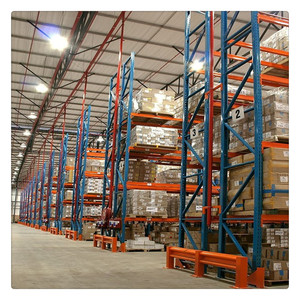
HEDAHeavy Duty Racking
 English
 Español
EnglishEspañolFrom standard selective pallet structures to automated 3,000kg shuttle bays and push-back nested cart systems, every fabrication is calculated strictly against your pallet footprint and dynamic wheel load.
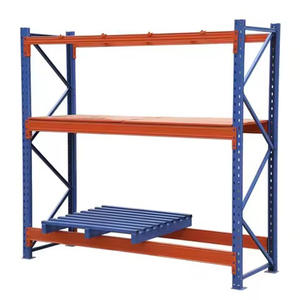
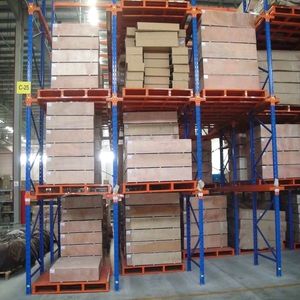
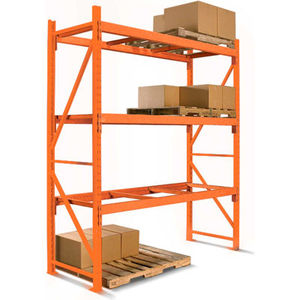
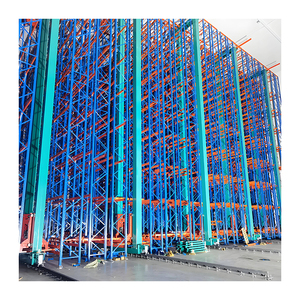
Modern distribution facilities and temperature-controlled cold rooms face an ongoing challenge: how to achieve extreme volumetric storage density without running into the high collision rates and slow handling speeds of traditional drive-in racking. Push back pallet racking addresses this bottleneck by employing an inclined structural rail track and nested carrier cart system operating on a Last-In, First-Out (LIFO) schedule.
Configured commonly from 2 to 6 pallets deep, a push-back bay utilizes gravity-assisted flow. The initial pallet is loaded directly by the forklift operator onto the top nested steel trolley. When depositing the second pallet, the operator uses the incoming unit to gently push the first cart backward along the structural steel rails, uncovering the second nested carrier beneath it. The reverse happens during retrieval: when a pallet is lifted off the front face, gravity causes the remaining rear carts to glide steadily toward the picking face at a controlled speed.
In drive-in racking configurations, lift trucks must travel deep inside the rack bays, creating a constant risk of frame impacts and structural fatigue. Push back systems, in contrast, allow the forklift to stay entirely in the central aisle. The structural integrity of uprights is significantly preserved, while picking productivity improves by roughly 30% to 45% compared to drive-in runs. Unlike live gravity flow systems which require dual-aisle access (one front aisle for loading, one rear aisle for discharge), push back operates from a single aisle footprint, preserving floor area in premium real estate such as sub-zero freezers and food processing buffers.
| System Attribute | Push Back Racking (Nested Cart) | Drive-In Pallet Racking | Standard Selective Racking |
|---|---|---|---|
| Cube Storage Density | High (Up to 75% Floor Utilization) | High (Up to 70% Floor Utilization) | Moderate (35%–40% Floor Utilization) |
| Forklift Entry Requirement | None (Operator stays in main aisle) | Mandatory (Drives inside upright bays) | None (Operates from access aisle) |
| Stock Rotation | LIFO (By individual lane) | LIFO (By entire bay channel) | FIFO / LIFO (100% Selective access) |
| Collision Risk Factor | Minimal (Front face loading only) | High (Frequent mast & upright friction) | Minimal (Clear aisle boundaries) |
| Typical SKU Profile | Medium batch (2–6 pallets per SKU) | Very low SKU count (Mass storage) | High SKU diversification |
As a verified CE-certified push back pallet racking manufacturer, Guangzhou Heda Shelves Co., Ltd. (HEDA) builds these systems using structural Q235B cold-rolled steel, engineered according to EN 15512 and FEM 10.2.02 standard load-deflection protocols. The design handles the dynamic shock loads that occur when a loaded forklift presses a 1,500kg unit against existing nested trolleys.
Fabricated with robotic seam welding, each trolley features heavy-duty steel wheels fitted with sealed precision bearings, maintaining balanced rolling friction across temperature swings from -30°C freezer operations to +45°C ambient warehouses.
Rails are fixed at a precision gradient (commonly between 2.5% and 3.5%). This ensures self-propelling gravity feed without causing dangerous terminal speeds when the cart moves toward the front beam face.
Front-facing mechanical end-stops and catch brackets keep the forward pallet locked securely in place, even when handling imperfect wooden pallets or minor forklift positioning variances.
The electrostatic powder-coating line provides an even, chip-resistant finish without welding slag. This smooth surface prevents corrosion in humid cold-storage facilities and simplifies the cleaning regimens required in pharmaceutical and food distribution environments.
The global warehousing landscape is adapting to shifting supply chain patterns, rising industrial land values, and stricter regional energy efficiency standards. B2B procurement managers evaluating push-back installations should keep these emerging technical trends in mind:
Rapid expansion in cold-chain logistics has created steady demand for push back installations. Because sub-zero refrigeration is energy-intensive, facility managers aim to pack as many pallet positions as possible into cold rooms. Push back racking's ability to maintain high density without needing the heated cab travel required by drive-in configurations makes it an economical choice for 3-deep and 4-deep frozen stock lanes.
Warehouses are increasingly pairing push back lanes on lower tier levels for fast dynamic manual case picking with automated shuttle systems or automated crane aisles overhead. This hybrid approach lets facilities maintain high throughput picking on the warehouse floor while using the higher vertical cubes for automated replenishment.
Procurement teams in seismic zones (such as Latin America, the US West Coast, and Southeast Asia) now routinely require dynamic acceleration modeling in place of simple static load calculations. Base plate anchoring has grown in surface area, with extra row-spacers and spine bracing installed to secure multi-deep nested carts against shifting along their inclined tracks during low-frequency earthquake tremors.
With wooden pallet quality varying across international supply chains, modern push back suppliers engineer carts with full structural cross-supports and containment lips. This helps prevent weak bottom boards from cracking or jamming the roller tracks.
With an operational presence dating back to 2001 in Pazhou, Guangzhou, Guangzhou Heda Shelves Co., Ltd. has established itself as an experienced manufacturer and technical partner for warehouse racking across Oceania, Europe, the Americas, Africa, and Southeast Asia.
Over 20 years of manufacturing experience across 5,000+ completed projects worldwide. Our facility beside the Canton Fair Complex makes on-site engineering audits straightforward for visiting international buyers.
Every batch of Q235B cold-rolled steel undergoes mill tensile testing, welding inspection, and physical load testing up to 4,500kg per level. System safety factors meet or exceed current international warehousing codes.
Our sales engineers review your architectural floor plans and equipment load profiles to deliver preliminary AutoCAD layouts and 3D concept renderings within 8 hours.
Components are pre-drilled and flat-packed to protect finished surfaces during container voyages while using shipping space efficiently, helping lower ocean freight costs per pallet location.
Bay clear heights, track pitch angles, carrier wheel compounds, upright column profiles, and company powder-coat finishes can all be adjusted to fit your operational requirements.
Push back pallet systems typically run between 2 and 6 pallets deep per lane. While 2 to 4 pallets deep is the most widely installed setup for balancing gravity pushback force with forklift push power, HEDA designs custom 5-deep and 6-deep nested trolley systems using precision low-resistance bearings and matched rail inclines.
Push back racking improves picking throughput by 30% to 45% over drive-in systems. Because the forklift never drives inside the rack uprights, mast and frame collisions are significantly reduced. The forklift operator completes all operations from the clear aisle, reducing handling cycles and extending rack service life.
Yes. We build cold-storage push back units with low-temperature rated steel, specialized bearing lubricants formulated down to -30°C, and thicker electrostatic powder coats or hot-dip galvanization to resist condensation, thermal cycling, and corrosion.
To deliver an AutoCAD proposal within 8 hours, our engineers typically need: warehouse interior clear heights, column positions and spacing, pallet dimensions (W x D x H, including overhang), maximum gross pallet weight, and the turning radius and lift height of your intended forklift.
Yes. As a direct factory manufacturer, HEDA keeps standard component specifications on file for every delivered project. Replacement nested trolleys, guide rails, flange rollers, and front-load bumpers can be manufactured and shipped to match existing bay runs.