HEDAHeavy Duty Racking
 English
 Español
EnglishEspañolFactory-direct structural steel racking components, automated shuttle rails, cantilever setups, and industrial display solutions designed by Guangzhou Heda Shelves Co., Ltd.
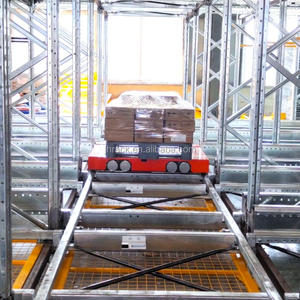
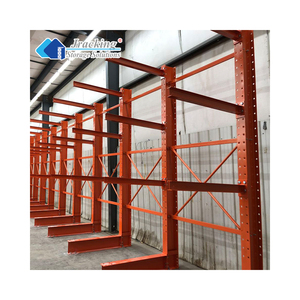
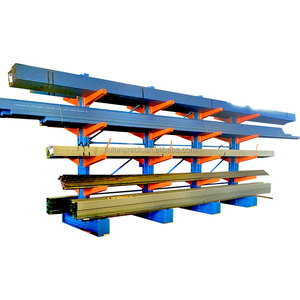
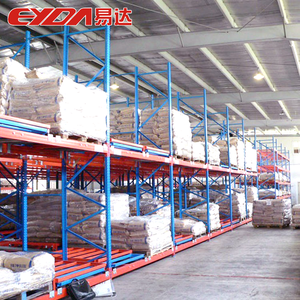
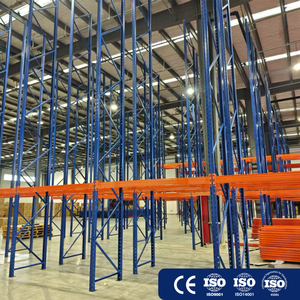
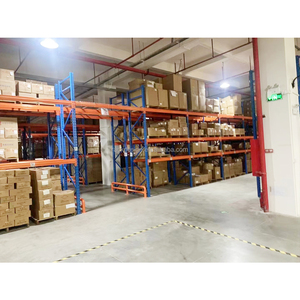
In modern high-throughput warehousing, vertical cube utilization and SKU accessibility define operational viability. While traditional selective pallet racking dedicates up to 65% of warehouse footprint to access aisles, heavy-duty drive-through racking systems consolidate floor space by eliminating intermediate corridors. Unlike drive-in racks that operate on a Last-In, First-Out (LIFO) protocol with a closed rear bracing frame, drive-through racking features an unobstructed open-ended corridor structure. Forklifts enter from one side for pallet deposit and enter from the opposite side for pallet retrieval, establishing an authentic First-In, First-Out (FIFO) logistics cycle.
Manufactured primarily from premium Q235B and Q355B cold-rolled structural steel, each drive-through upright column profile undergoes precision roll-forming with multi-bend stiffeners to withstand combined axial compression, torsional loads, and lateral impact force. Guangzhou Heda Shelves Co., Ltd. incorporates structural steel guide angles (typically 75×75×6mm to 100×100×8mm) bolted directly into concrete slabs with heavy-duty chemical anchors. This prevents material handling equipment (counterbalance or reach trucks) from colliding with the vertical upright frames during deep-channel maneuvering.
Since rear cross-bracing cannot be deployed in open-ended drive-through bays, structural integrity is guaranteed via overhead structural tie beams, horizontal diagonal grid bracing, and double-cantilever welded steel brackets engineered against transverse seismic deflection.
Pallets sit on heavy-gauge roll-formed support tracks with flared entries. Rails feature a sloped entry lip and built-in pallet centring retainers to ensure accurate fork positioning and prevent side-slipping under concentrated loads exceeding 1,500 kg per pallet.
Equipped with reinforced structural floor channels, yellow-coated steel guide shoes, and high-impact column guards. Our safety enclosures absorb kinematic vehicle contact forces, preserving structural alignment across high-frequency operations.
| Evaluation Parameter | Drive-Through Racking | Drive-In Racking | Radio Shuttle Racking | Standard Selective Racking |
|---|---|---|---|---|
| Inventory Flow Principle | First-In, First-Out (FIFO) | Last-In, First-Out (LIFO) | FIFO or LIFO Selectable | Random Direct Access (FIFO/LIFO) |
| Cubic Storage Utilization | 75% – 85% Efficiency | 75% – 85% Efficiency | 85% – 92% Highest Density | 40% – 50% High Aisle Waste |
| Forklift Truck Interaction | Drives Inside Racking Lanes | Drives Inside Racking Lanes | Operates at Aisle Face Only | Operates in Standard Aisles |
| Structural Bracing Method | Top Tie Beams & Portals Only | Top Bracing & Back Cross Frames | Internal Tie Bracing & Rail Ties | Horizontal & Diagonal Webbing |
| Pallet Depth per Channel | 5 to 12 Pallets Deep | 5 to 15 Pallets Deep | 20 to 50+ Pallets Deep | Single or Double Deep (1 to 2) |
| Best Application Scenario | Cold Storage, Perishables, Batch FIFO | Homogeneous Non-Perishables | Mega Cold Chain, Automated Hubs | High SKU Variance, Low Volume |
| Capital Expenditure (CapEx) | Moderate (Pure Structural Steel) | Moderate (Pure Structural Steel) | High (Robotics & Charging Bays) | Low Initial Investment |
Procurement directors and supply chain engineers are no longer purchasing static warehouse iron based strictly on steel tonnage. Strategic buyers are pivoting toward adaptable, digitally monitored, and energy-conserving storage architectures. Four macroeconomic and engineering trends are transforming how heavy-duty drive-through racking is specified and sourced across global markets:
1. Hybridization with Pallet Shuttle Carriers: Standard drive-through racking requires forklift drivers to navigate deep into structural tunnels, creating ergonomic friction and vehicle impact risks. The industry is seeing rapid adoption of "automation-ready" drive-through profiles where continuous steel rails can host autonomous pallet runners (such as our 4-Way Pallet Shuttle System). This hybrid layout converts a manual drive-through frame into a semi-automated picking cube with minimal retooling.
2. Advanced Cold Chain & Sub-Zero Surface Metallurgy: With refrigerated warehousing expenses surging worldwide, maximizing cubic thermal volume is mandatory. In -25°C to -30°C cold storage, standard low-grade carbon steel undergoes brittle-ductile transition hazards. Global buyers now specify certified Q235B/Q355B structural steel with verified low-temperature impact toughness, paired with upgraded electrostatic thermoset powder coatings (60–90 microns) or pre-galvanized hot-dip coatings to prevent condensation micro-corrosion.
3. FEA-Driven Seismic Engineering (FEM 10.2.02 / RMI Compliance): Earthquake-prone zones across the Americas (Chile, Mexico, US West Coast) and Asia-Pacific demand certified finite element analysis (FEA). Because drive-through racking lacks cross-bay back bracing, horizontal shear capacity relies heavily on column-to-baseplate anchored moments. Modern buyers require extended dual-anchor baseplates, seismic heavy duty bracing brackets, and verified dynamic deflection modeling before awarding production contracts.
4. Modular Knock-Down Geometries for Containerized Freight Optimization: Extreme international container shipping rates have made knock-down design a primary procurement metric. Guangzhou Heda Shelves Co., Ltd. designs upright frames, cantilever support arms, and continuous guide rails with precision CNC-punched bolt assemblies. This knockdown format maximizes shipping container packing density by over 30%, drastically lowering per-pallet landed logistics costs.
Located adjacent to the Canton Fair Complex in Pazhou, Guangzhou, HEDA Shelves delivers turn-key engineering, manufacturing, and export delivery across five continents.
Over two decades of precision manufacturing with 5,000+ completed storage projects worldwide.
Drive-Through, Shuttle, Selective, Cantilever Racking, Mezzanines, and Commercial Display Systems.
Custom upright pitches, load brackets, rail lengths, seismic footplates, and tailored RAL color finishes.
Strict raw material mill checks, automated continuous welding, powder coating thickness, and load testing.
Direct communication with structural engineers who supply AutoCAD layouts and 3D designs within 8 hours.
Procuring heavy-duty drive-through racking from China requires rigorous technical specifications to avoid structural bottlenecks, fork clearance issues, or costly on-site modifications. Ensure your Request for Quotation (RFQ) accounts for the following engineering variables:
1. Clear Pallet Interface & Overhang Geometry: Specify total pallet dimensions (W×D×H) including actual cargo overhang. Drive-through support rails support pallets along their outer edges (typically 50mm to 75mm lip). An undersized pallet width or compromised pallet runner can cause drops inside the rack tunnel. We advise a minimum horizontal rail-to-rail clearance calculation based on pallet bottom runner orientations.
2. Forklift Mast & Overhead Guard Tolerances: Because material handling equipment enters the racking bay directly, measure the overall mast height, cab width, and overhead guard dimensions. A clearance of not less than 75mm (preferably 100mm) must be maintained between the forklift's outermost edges and the racking guide channels.
3. Upright Baseplate Thickness & Floor Anchor Statics: In drive-through systems, lateral impact force transfers directly to the floor. Baseplates must be laser-cut from high-strength structural plate steel (minimum 8mm to 12mm thickness) with dual or quadruple anchor holes. Expanding chemical anchors must embed properly to resist high overturning moments during unladen forklift reversing.
4. Protective Galvanized vs. Powder Coated Finishes: Determine your operating environment. For dry goods distribution, HEDA's automated powder-coating line cures an epoxy-polyester coating at 200°C, offering durable scratch resistance. For blast freezers, ambient humidity condensation zones, or chemical warehousing, specify hot-dip galvanizing with minimum 65-micron coating thickness.
Detailed answers to critical engineering, safety, and logistical questions regarding heavy-duty drive-through racking systems.
Drive-in racking operates on a Last-In, First-Out (LIFO) protocol with a closed rear bay supported by permanent X-bracing. Drive-through racking is open at both ends, allowing loading from one side and unloading from the other for true First-In, First-Out (FIFO) handling. Structurally, drive-through racks cannot use rear cross-bracing and must rely on overhead portal tie beams and reinforced upright anchoring to maintain lateral stability.
Our heavy-duty drive-through systems are engineered to support 500 kg to over 2,000 kg per pallet position, translating to bay loads of 15,000 kg or more depending on level count and column profile. Upright sections range from 80×60mm up to 120×95mm in Q235B cold-rolled steel, verified with finite element static calculations against FEM 10.2.02 and RMI standards.
We install heavy-duty floor-mounted structural guide channels (angle or channel steel) along the full length of each storage lane. Entry points feature flared, brightly powder-coated wrap-around column protectors and heavy floor-anchored guide shoes that direct forklift wheels safely into the bay without contacting the vertical upright columns.
Yes. For earthquake-prone regions (such as the West Coast of the Americas or Southeast Asia), we integrate oversized structural baseplates (10–14mm thick), dual concrete chemical anchoring systems, reinforced top portal frames, and heavy-duty arm bracket connectors to resist seismic moments and prevent channel twisting.
Drive-through and drive-in systems are widely used in cold storage due to their high cubic density, which minimizes wasted refrigerated space. For facilities operating down to -30°C, we utilize certified impact-resistant structural steel and special low-temperature electrostatic powder coatings or hot-dip galvanized finishes to prevent embrittlement and corrosion.
Due to concentrated point loads beneath the upright posts, warehouse concrete slabs typically require a minimum thickness of 180mm to 250mm, with a compressive strength of at least C20/25 (preferably C30/37). Floor flatness must meet DIN 18202 or ASTM E1155 standards (typically FM2 or FF/FL equivalent) to prevent forklift mast tilt within narrow internal lanes.
All structural components are roll-formed from first-tier Chinese mill Q235B cold-rolled steel. Our manufacturing line uses automatic multi-head punching, robotic welding, and an automated continuous electrostatic powder-coating line that includes degreasing, phosphating, and 200°C curing to deliver a durable, slag-free finish.
Components are engineered with a fully knock-down modular geometry. Upright frames are either pre-assembled or nested flat, pallet rails are strapped in steel cradles with protective cushioning, and smaller hardware parts are palletized in wooden crates. This approach protects paint finishes, eliminates shipping distortion, and maximizes container cubic capacity.
Send us your warehouse CAD floor plan, pallet dimensions, cargo weights, and forklift specifications. Our engineering team will deliver structural calculations, layout drawings, and a direct factory quotation within 8 hours.