HEDAHeavy Duty Racking
 English
 Español
EnglishEspañolExplore our certified cold-rolled steel storage series designed to international FEM 10.2.02, RMI, and AS 4084-2023 structural standards for extreme industrial warehousing.
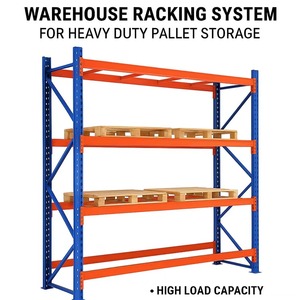
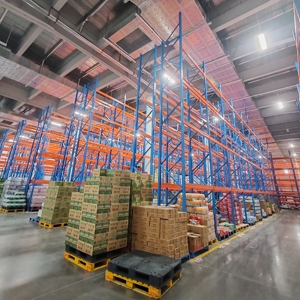
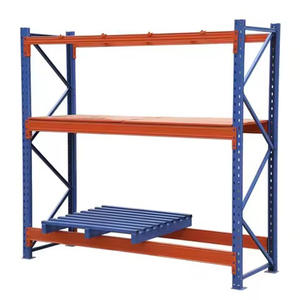
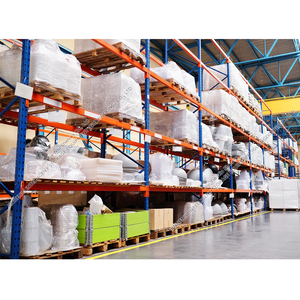
A rigorous examination of Chinese cold-formed structural steel manufacturing, load capacity validation, and design safety coefficients under dynamic warehouse conditions.
In modern industrial logistics, an industrial storage shelving rack is no longer regarded as static steel carpentry; it operates as an engineered structural skeleton subjected to complex triaxial stress tensors, dynamic mast harmonics from counterbalanced forklifts, and severe seismic acceleration forces. Procuring industrial storage shelving and heavy-duty pallet racks from China requires procurement directors and facility engineers to look far deeper than unit price per kilogram. Structural integrity begins at the microscopic metallurgical level: the yield strength (fy), elongation percentage, and chemical composition of the primary coil.
Premier Chinese exporters utilize refined Q235B and Q355B cold-rolled carbon steel, conforming strictly to GB/T 700-2006 and EN 10025 standards. Q235B provides a nominal yield point of 235 MPa with remarkable ductility (elongation ≥ 26%), making it an ideal choice for upright columns and interlocking box-beams where energy dissipation and cyclic elastic recovery are critical. In seismic regions or ultra-high-bay facilities exceeding 12 meters, Q355B low-alloy high-strength steel is specified, raising yield resilience to 355 MPa and delivering high structural modulus while lowering the overall deadweight of the racking matrix.
Deflection Metric Standard (FEM 10.2.02 / ANSI MH16.1): Under full design operational loading (UDL – Uniformly Distributed Load), maximum vertical beam deflection must never exceed L/200 for standard reach operations, and L/300 for automated crane or guided very narrow aisle (VNA) systems, where L represents the clear span between adjacent upright frames.
Upright roll-forming profiles utilize an omega-shape geometry boasting up to 12 distinct bending-plane folds. Each return flange and secondary fold dramatically improves the section's radius of gyration, counteracting local plate buckling, torsional flexural buckling, and distortional modes. Before mass production, computer-aided Finite Element Analysis (FEA) simulates multi-story cyclic frame loading, ensuring that connector claw brackets, seismic baseplates, and horizontal/diagonal frame bracings stay well beneath allowable Von Mises stress thresholds.
Evaluate volumetric storage efficiency, selectivity percentages, equipment compatibility, and unit pallet economics across industrial rack topologies.
| Racking Topology | Storage Density | SKU Selectivity | Max Load / Level | Forklift Compatibility | Relative Cost / Pallet | Primary Industrial Use-Case |
|---|---|---|---|---|---|---|
| Selective Pallet Racking | Baseline (40–45%) | 100% Direct Access | 1,000–4,500 kg | Standard Counterbalance, Reach | $ (Economic Benchmark) | FMCG, 3PL logistics, multi-SKU retail distribution |
| Double-Deep Pallet Racks | High (+30% vs Selective) | 50% (Two-deep slotting) | 1,500–3,500 kg | Pantograph Reach Truck | $$ (Moderate) | Pharmaceutical bulk, secondary distribution hubs |
| Drive-In / Drive-Thru | Very High (Up to 75%) | Low (FILO / FIFO lanes) | 1,000–2,000 kg | Narrow-Chassis Counterbalance | $$$ (Capital Intensive) | Cold storage, seasonal harvest, homogeneous SKUs |
| Radio Shuttle Automation | Ultra High (85%+) | Programmed Batch Access | 1,500–2,500 kg | Standard Forklift + Auto Carrier | $$$$ (Tech Integrated) | Sub-zero freezers, large raw material manufacturing |
| Industrial Mezzanine Platform | Custom Cubic Multiply | 100% Floor Access | 500–1,200 kg / m² | Hand Pallet Trucks, VRC Cargo Lifts | $$$ (Per square meter) | E-commerce bin fulfillment, assembly workshops, parts |
| Heavy-Duty Cantilever | Variable Open Pitch | 100% Linear Access | Up to 2,500 kg / arm | Side Loaders, 4-Way Multi-Directional | $$$ (Specialized Column) | Steel pipes, timber bundles, extrusions, structural profiles |
Critical trends reshaping international warehouse infrastructure procurement from Chinese manufacturing epicenters.
Procurement teams are shifting away from forgiving manual forklift racks toward automated storage and retrieval systems (ASRS) and autonomous mobile robot (AMR) compatibility. This demands tight dimensional tolerances: upright deviation within ±1.5mm over a 12m height and automated robotic welding to prevent deflection variance in automatic crane aisles.
Despite spikes in regional freight rates, the deep integration of China's upstream metallurgical supply chain in Guangdong creates unmatched unit-cost economics. Direct OEM partnerships offset landed shipping overhead through custom knock-down containerization configurations, yielding a 25–40% TCO advantage over regional European or North American fabricators.
Global ESG compliance has made low-VOC electrostatic thermosetting polyester powder coating non-negotiable. Modern Chinese suppliers eliminate heavy metal degreasers in favor of 9-stage silane nano-ceramic pre-treatments, delivering >500 hours of neutral salt spray corrosion resistance while drastically slashing carbon intensity per fabricated metric ton.
Transforming raw steel coils into smart, collision-resistant, and climate-hardened industrial storage infrastructure.
Modern production incorporates computer-controlled punching and roll-forming lines capable of handling steel coils up to 4.0mm thickness without micro-fissuring at the fold radii. Laser-guided punch systems maintain pitch hole centers with ±0.1mm repeatability across a 15-meter single-piece beam or upright run.
Standard carbon steel experiences ductile-to-brittle transition below zero degrees Celsius. By balancing silicon and manganese additions and reducing phosphorus/sulfur traces (≤ 0.025%), our cold-room formulations retain high Charpy V-notch impact toughness at -35°C, preventing spontaneous structural cleavage in cold storage operations.
High-bay installations can now incorporate beam-mounted wireless strain gauges and vertical upright impact sensors. These low-power mesh nodes broadcast real-time deflection alerts and log forklift collisions directly to warehouse management systems (WMS), preventing catastrophic progressive structural collapses.
A proven manufacturing powerhouse based in Guangzhou, engineered to streamline global supply chains from design to container loading.
Over two decades of structural racking fabrication, export logistics, and worldwide installation experience.
Factory located in Pazhou, adjacent to Canton Fair complex for rapid on-site customer inspections and factory audits.
300+ certified production welders, mechanical engineers, and export specialists maintaining 3,000+ tons monthly volume.
Every batch undergoes steel spectrometry, weld penetration tests, electrostatic adhesion checks, and full load tests.
Precision-engineered knock-down components maximize container cubing, reducing ocean freight costs by up to 30%.
Expert answers addressing technical safety specifications, logistics optimization, and international trade compliance.