Global Logistics Infrastructure & Industrial Storage Engineering

China Top Warehouse Storage Shelving Supplier & Exporters

Direct factory high-capacity pallet racking, automated shuttle matrixes, and multi-tier industrial mezzanine platforms engineered since 2001.

Engineered Selection

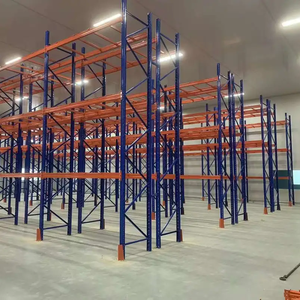
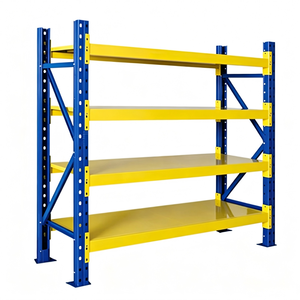
Heavy-Duty Warehouse Shelving & Structural Pallet Racking Systems

Precision-fabricated from premium Q235B cold-rolled structural steel, tested to comply with international RMI, FEM 10.2.02, and AS4084-2012 seismic and dynamic load specifications.

Why Global Contractors Partner With HEDA

Enterprise Manufacturing Advantages & Export Engineering

Guangzhou Heda Shelves Co., Ltd. has delivered factory-direct warehouse storage racks and retail shelving systems since 2001, minimizing procurement risk through end-to-end structural engineering.

20+ Years Proven Mastery

Over two decades dedicated strictly to racking fabrication, powering 5,000+ commercial projects across 130+ nations without structural failures.

Turnkey CAD/3D Modeling

Complete spatial planning before production. We simulate forklift turning radiuses, aisle clearances, picking access, and dynamic load stress distributions.

Tailored OEM / ODM Custom

Bespoke beam lengths, upright profiles (up to 120mm width), bespoke gauge thicknesses (1.5mm to 3.0mm), powder coat RAL matching, and carton branding.

Q235B Strict Quality Testing

Raw material tensile certification, ultrasonic weld line scrutiny, salt-spray corrosion analysis, and full-scale bay deflection proof load trials up to 4.5 tons.

8-Hour Technical SLA

Direct communications with bilingual structural engineers. Receive layout revisions, freight optimization quotes, and compliance dossiers within 8 hours.

2001
Inception Year
30,000+
Sqm Manufacturing Base
3,000 T
Monthly Production Capacity
300+
Certified Racking Technicians
5,000+
Delivered Global Projects
Procurement Intelligence

Future Trends in Industrial Warehouse Storage & Pallet Racking

Strategic analysis for supply chain directors, industrial real estate developers, and warehouse EPC contractors navigating space constraints and automated throughput demands.

1. Shift Toward Semi-Automated Radio Shuttle and AS/RS Compatible Frameworks

Industrial warehousing is undergoing a rapid transition from conventional wide-aisle static storage to automated density systems. Escalating commercial real estate prices and climbing cold storage energy consumption are prompting buyers to shift toward four-way pallet shuttle channels and Automated Storage and Retrieval Systems (AS/RS).

In contrast to standard selective pallet racking that allocates approximately 60% of floor space to forklift maneuvering aisles, automated radio shuttle bays achieve up to an 85% cubic space utilization rate. Modern racking procurement mandates tighter manufacturing tolerances. At HEDA Racking, guide rails, beam deflections (limited to 1/200th of span), and upright plumbness are engineered to millimeter precision to avoid automated shuttle guide jamming and sensor misalignments.

2. Steel Metallurgy: Cold-Rolled Q235B vs. High-Yield Q355B Under Dynamic Strain

Procuring durable warehouse storage racking requires a comprehensive understanding of structural metallurgy. Standard commodity shelving relies on recycled or inconsistent hot-rolled steel profiles prone to premature micro-fracturing under cyclic dynamic forklift impacts.

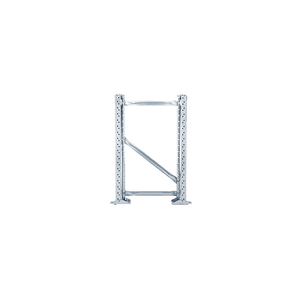
Premium China manufacturers engineer racking utilizing certified Q235B and Q355B cold-rolled structural sheet coils. The cold-rolling process yields an elevated yield strength (minimum 235 to 355 MPa), uniform tensile integrity, and optimized grain direction across the Omega-profile upright posts. Upright sections feature up to 13 mechanical bends along the profile perimeter, exponentially boosting post buckling resistance without adding excessive deadweight to structural foundation slabs.

Racking Type Space Utilization Direct Selectivity Typical Load / Level Ideal Application Profile
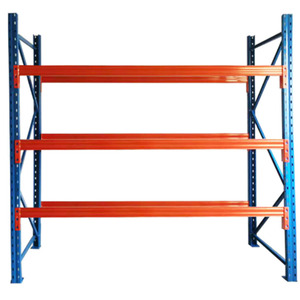
Selective Pallet Racking 40% - 50% (Wide Aisle) 100% (Instant Pick) 1,000 - 4,500 kg FMCG, general distribution, multi-SKU retail hubs.
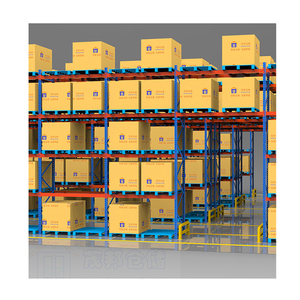
Drive-In / Drive-Through 65% - 75% (High Density) Low (LIFO / FIFO Lanes) 1,000 - 2,000 kg Bulk homogeneous items, seasonal cold storage, beverage bottling.
Radio Shuttle System 80% - 88% (Max Cube) Medium-High (Matrix) 1,000 - 1,500 kg Automated cold chains, high-turnover logistics mega-centers.
Heavy Duty Cantilever Variable (Linear Flow) 100% (Free Front Arm) 500 - 2,500 kg / arm Timber, structural pipes, metal bars, oversized sheet goods.
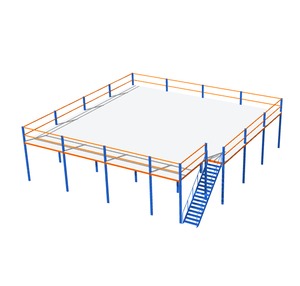
Multi-Tier Mezzanine Platform Doubles/Triples Floor 100% (Manual / Bin) 300 - 1,000 kg / sqm E-commerce fulfillment centers, spare parts picking, archive records.

3. Environmental Coating Standards & Sub-Zero Cold-Chain Durability

Surface degradation remains a leading driver of premature racking replacement. Global safety inspectors look closely at chemical pre-treatment and paint adhesion. In modernized Chinese export facilities, components pass through continuous automatic nine-stage chemical pretreatment baths (including de-greasing, surface conditioning, zinc-iron phosphating, and demineralized rinses) prior to powder application.

For standard temperature dry warehouses, electrostatically applied epoxy-polyester thermosetting powders baked at 180°C–200°C create a 70–90 micron layer resistant to impact flaking. For sub-zero cold-chain facilities operating between -20°C and -35°C, micro-cracking caused by steel thermal contraction demands continuous hot-dip galvanizing (HDG) or Sendzimir pre-galvanization conforming to ISO 1461, eliminating peel risks in high-humidity chillers.

Upgrade Your Facility Storage Density With Direct Factory Pricing

Connect with our structural engineering desk. Send us your warehouse DWG architectural layout or rack schedule, and receive structural calculations, 3D spatial renders, and full CIF/DDP cost estimations within 8 hours.

Procurement Guidance

Frequently Asked Questions for Overseas Racking Buyers

Engineering, customs, packaging, and structural stability answers for global logistics developers.

What specific structural parameters are needed to engineer a warehouse racking quote?
To provide an accurate structural quotation and layout drawing, our engineering team requires: (1) Clear building ceiling height and clear height below sprinkler heads, (2) Pallet dimensions including overall load overhang (Width x Depth x Total Height), (3) Maximum weight per pallet (Gross Pallet Load), (4) Operational forklift model, lifting mast height, and minimum turning radius, and (5) Regional building code details such as seismic design categories (IBC/UBC requirements) or cold-storage sub-zero operating environments.
What international testing and quality standards does HEDA Racking comply with?
Our storage racking systems are engineered, manufactured, and deflection-tested in strict compliance with the European Racking Federation FEM 10.2.02 (Design of Static Steel Pallet Racking), European Standard EN 15512, American RMI (Rack Manufacturers Institute) standards, and Australian Standard AS4084-2012 for Steel Storage Racking. We maintain active ISO9001 quality management certifications and provide mill material test certificates (MTC) with every export batch.
How are knocked-down racking components packed to avoid damage and optimize container freight?
All structural upright frames and beam levels are designed as fully demountable, knocked-down assemblies. Upright frames are nested with air-cushioned pearl wool separation, edge protectors, and heavy-duty steel strap binding. Horizontal beams are bundled on dedicated dunnage channels to allow rapid un-stuffing with forklifts. Hardware and baseplates are sealed in moisture-proof wooden crates. This packaging logic routinely yields a 95%+ 40ft High Cube container volumetric filling efficiency, minimizing per-pallet ocean freight rates.
Can HEDA customize racking for active seismic zones or high-wind coastal regions?
Yes. For earthquake-prone regions such as Latin America, the Pacific Rim, or New Zealand, our engineering desk integrates expanded structural baseplates, dual-anchor post connections, thickened bracing diagonals, and top tie-beams designed to absorb horizontal seismic shear accelerations without progressive structural collapse. All dynamic deflection models are validated via FEA (Finite Element Analysis) software.
What is the typical manufacturing lead time for full container load (FCL) orders?
Standard OEM production cycles for 1 to 3 forty-foot high cube containers (40HQ) range from 15 to 20 business days from drawing sign-off and deposit receipt. For complex automated shuttle systems, multi-tier mezzanine floors, or customized powder colors outside standard RAL codes, lead times average 25 days. Urgent construction project batches can be staged across sequential shipping schedules.
Do you supply on-site installation supervision and assembly instructions for local crews?
Yes. Every export shipment includes bilingual step-by-step 3D assembly manuals, structural bay identification tags, and fastener torque specification charts. For large-scale logistics centers exceeding 5,000 square meters, we can dispatch veteran site supervisors to guide local contracting teams or conduct live video supervisory sessions throughout the upright plumbness and beam locking phase.