HEDAHeavy Duty Racking
 English
 Español
EnglishEspañolEngineered for high-bay logistics centers, automated picking terminals, cold chains, and multi-tier modular retail distributions worldwide.
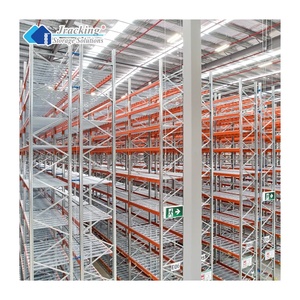
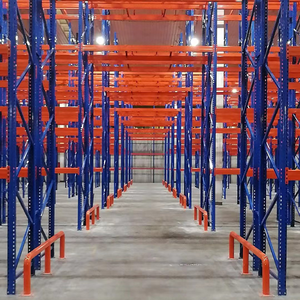
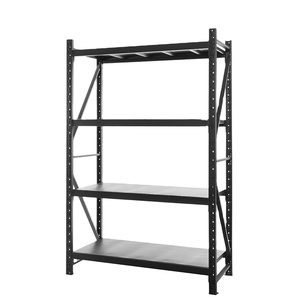
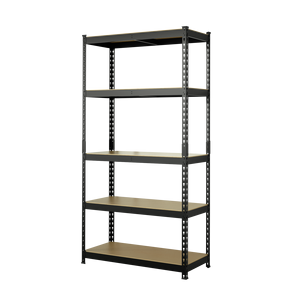
A rigorous industrial perspective on metallurgy, beam deflection tolerances, dynamic load calculation, and surface treatment integrity for international B2B purchasers.
In modern structural warehouse engineering, raw material composition dictates failure thresholds. The standard baseline adopted by premier Chinese industrial shelving manufacturers like HEDA Racking is Q235B cold-rolled structural carbon steel, compliant with GB/T 700-2006, ASTM A36, and European EN 10025-2 S235JR standards. Compared to cheaper scrap-melted metals or commercial-grade steels lacking batch certifications, certified Q235B guarantees a minimum yield strength ($R_{eH}$) of 235 MPa and a tensile strength range ($R_m$) between 370 and 500 MPa with an elongation coefficient exceeding 26%.
Cold-rolling processes yield enhanced surface uniformity and precise dimensional tolerances across upright columns and step beams. Upright profiles subjected to roll-forming achieve critical cold work hardening, reinforcing tensile capacity along the corner radii where lateral bending moments concentrate during forklift impact or seismic acceleration. HEDA Racking provides mill test certificates (MTC) containing complete chemical spectrometry (Carbon ≤ 0.20%, Sulfur ≤ 0.045%, Phosphorus ≤ 0.045%) with every exported container, guaranteeing uncompromised structural traceability.
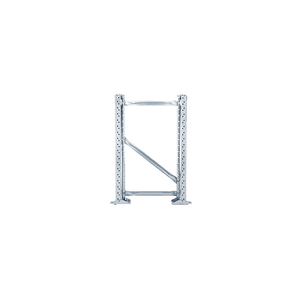
Heavy-duty pallet racking and multi-tier industrial shelving performance rely on box-beam profiles (interlocking welded C-channels) or step-beam configurations designed to seat steel decking, wire mesh decks, or pallet cross bars. Engineering safety coefficients must comply with RMI (Rack Manufacturers Institute) MH16.1 and FEM 10.2.02 specifications. The vertical deflection limit of any load-carrying horizontal member is strictly calibrated not to exceed:
Maximum Allowable Deflection = Span Length (L) / 200 (Under Full Design Safe Working Load)
Beam end connectors feature precision multi-tooth claw fixtures (3-claw, 4-claw, or 5-claw options depending on intended shear ratings) laser-stamped with tight angular geometry. These claw fixtures interface with teardrop, diamond, or trapezoidal upright perforations at standard 50mm or 75mm pitches. Once seated, self-locking industrial spring safety pins withstand an upward mechanical shear force of over 10 kN per connection point, eliminating accidental dislodgement caused by forklift mast errors during vertical retrieval operations.
Corrosion resistance determines equipment lifecycle in coastal distribution hubs, high-humidity climates, and cold storage applications. HEDA employs an automated nine-stage chemical pre-treatment cycle including high-pressure alkali degreasing, twin cold-water rinses, acid derusting/pickling, micro-crystalline phosphating, and deionized water cleansing. This continuous loop chemically passivates the cold-rolled steel surface, creating an optimal nano-porous anchor profile for powder adhesion.
Thermoset epoxy-polyester hybrid powder resins are electrostatically deposited at 70–90 kV potential, followed by curing inside a 200°C convective baking tunnel for 25 minutes. The resulting polymer matrix provides an impenetrable dry film thickness (DFT) between 65 μm and 85 μm, tested to survive 500+ hours of continuous neutral salt spray exposure (ASTM B117) and 2H pencil hardness scratch tests without micro-fracturing or delamination. For deep freeze environments down to -30°C, custom hot-dip galvanization (HDG compliant with ISO 1461) delivers lifelong cathodic sacrificial protection against frost condensation and rust pitting.
| Racking Architecture | Typical Payload / Layer | Optimal Bay Height | Material Specification | Core Application Logistics |
|---|---|---|---|---|
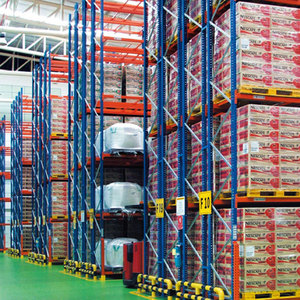
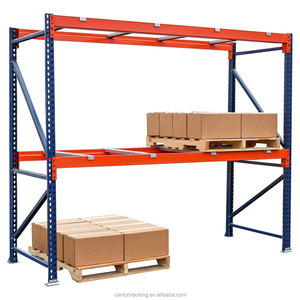
| Selective Pallet Racking | 1,000 kg – 4,500 kg | Up to 12.0 Meters | Q235B Roll-Formed Steel | Fast-turnover distribution centers, 100% SKU access |
| Double Deep Pallet System | 1,000 kg – 2,500 kg | Up to 10.0 Meters | Q235B High-Yield Channel | High-density warehousing, specialized pantograph reach trucks |
| Heavy Duty Cantilever | 500 kg – 2,500 kg / Arm | Up to 8.0 Meters | Structural H-Beam / Hot-Rolled | Timber yards, steel piping, long extruded profiles |
| Multi-Tier Mezzanine Floor | 300 kg – 1,000 kg / m² | Up to 3 Tiers (9m) | C-Section / Galvanized Grating | E-commerce order fulfillment, manual picking zones |
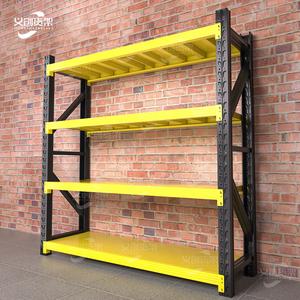
| Boltless Slotted Shelving | 200 kg – 600 kg / Tier | 1.8m – 3.0 Meters | Cold-Rolled Steel Plate | Industrial workshops, automotive spare parts, archives |
Market dynamics, robotic automation, and supply chain volatility are reshaping procurement mandates for global storage infrastructure buyers.
Standard warehouse racking is rapidly transforming into automation-ready infrastructure. Modern buyers demand tight dimensional tolerances (±1.5mm) across aisle spans to accommodate autonomous guided vehicles (AGVs) and autonomous mobile robots (AMRs). Racking designs must integrate reflective positioning sensors, smooth floor transitions, reinforced bottom upright guides, and customized pallet backstops that interface seamlessly with warehouse control software (WCS) and optical barcode scanners.
Ocean freight volatility makes shipping volume (CBM) a primary total cost of ownership (TCO) variable. Future-ready procurement focuses on fully knock-down, nested beam structures, modular bolted upright frames, and interlocking shelving panels that maximize shipping container space. By engineering profiles that nest seamlessly into standard 40ft High Cube (40HQ) containers, HEDA helps buyers increase payload fill rates up to 92%, saving between 18% and 34% on transpacific and transatlantic shipping costs.
Global engineering tenders, particularly in earthquake-prone regions such as the Pacific Rim, Latin America (Chile, Ecuador, Peru), and Southern Europe, now require finite element analysis (FEA) compliant with Eurocode 8 and AS 4084 standards. Buyers are abandoning generic catalog racks for verified seismic configurations featuring expanded footplate foundations, reinforced diagonal back-bracing, high-ductility anchor studs, and specialized portal ties that absorb ground shock energy without progressive catastrophic collapse.
Combining 20+ years of manufacturing expertise with stringent internal quality assurance and comprehensive export engineering support.
Established in 2001 in Pazhou, Guangzhou, with over two decades of production and structural testing expertise.
From 4.5-ton pallet racks, cantilevers, and shuttle lanes to boltless store fixtures from one integrated supplier.
Full OEM/ODM engineering including custom beam lengths, punch profiles, heavy footplates, and RAL colors.
Ultrasonic weld inspection, destructive load testing, and powder coat adhesion verified before shipping.
Bilingual structural sales engineers review 3D layouts, loads, and BOM requirements within 8 business hours.
Direct technical answers addressing structural calculations, international compliance, packaging safety, and delivery timelines.
We engineer solutions across all payload tiers: medium-duty boltless shelving from 300 to 800 kg per level, heavy-duty industrial pallet racking rated up to 4,500 kg per level, mezzanine floors designed for 800 to 1,000 kg/m² uniform distributed load (UDL), and cantilever arms supporting up to 2,500 kg per level. Every structural component is verified against pallet footprint, building height, floor slab capacity, and forklift reach parameters.
All production uses premier prime Q235B cold-rolled structural steel coils purchased directly from top domestic state-owned mills like Baosteel and Shougang. Mill Test Certificates (MTCs) detailing carbon, phosphorus, and sulfur content, as well as tensile and yield metrics, are provided with every delivery batch to ensure complete structural compliance with international project specifications.
Yes. Our internal team of structural CAD engineers provides full warehouse space layouts, 3D renderings, and seismic structural simulations before order sign-off. We calculate optimal aisle widths based on your forklift turning radii (counterbalance, reach truck, or VNA turret truck), building column spacing, fire protection sprinkler clearances, and emergency egress corridors.
Components are packaged using knock-down (KD) configurations to maximize container space and reduce freight costs. Uprights and beams are banded with protective steel strapping and corrugated edge protectors, then cushioned with water-resistant bubble wrap and stretch film. Small parts such as connectors, baseplates, safety pins, and anchor bolts are crated in seaworthy fumigated wooden boxes.
Yes. For clients in seismically active regions across South America, Oceania, Southeast Asia, and the Mediterranean, we engineer systems featuring oversized baseplates, heavy anchor bolts, top-tier portal cross-braces, and reinforced diagonal support framing designed to dissipate seismic energy and prevent structural rack collapse.
Standard production runs for customized warehouse and retail shelving systems average 15 to 25 calendar days, supported by our 3,000-ton monthly capacity. For customized industrial shelving or heavy-duty pallet racking systems, our standard baseline MOQ is typically a 20GP shipping container, allowing cost-effective container loading and optimal freight pricing.
Send your architectural DWG drawings, pallet specifications, and payload criteria. Our senior engineering sales team will supply layout plans, 3D renderings, and transparent FOB/CIF pricing within 8 hours.