HEDAHeavy Duty Racking
 English
 Español
EnglishEspañolDirect from our 30,000m² manufacturing facility in Guangzhou, China. Engineered to FEM 10.2.02, EN 15512, and ANSI MH16.1 specifications with certified quality control.
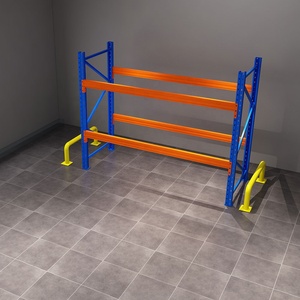
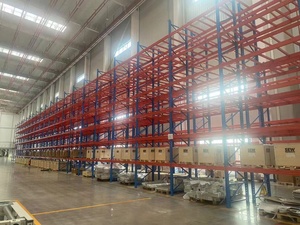
In modern intralogistics, spatial density and throughput velocity often exist in a state of operational tension. Standard selective pallet racking delivers 100% SKU selectivity but squanders up to 60% of total facility cubic footage on forklift travel aisles. Conversely, traditional drive-in racking achieves density at the steep cost of honeycombing, severe forklift impact risks, and sluggish operational cycle times. As a leading China wholesale push back racking manufacturer & exporter, Guangzhou Heda Shelves Co., Ltd. engineers dynamic cart-on-rail accumulation systems that resolve this classic supply chain dilemma.
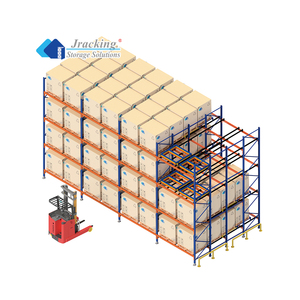
Push back pallet racking operates on an inclined, gravitational counter-thrust principle. Pallets are staged on a series of nested rolling carts that glide along structural steel channel rails inclined at a precise gradient, typically between 1.5% and 2.5% (approx. 1 to 1.5 degrees). When a standard counterbalance or reach truck deposits the initial pallet into a lane, it rests securely on the top carriage. To stage the subsequent pallet, the forklift operator aligns the load and gently exerts forward pressure against the first unit, pushing it back along the rail trajectory and exposing the secondary sub-cart beneath. This kinematic sequence repeats for 2-deep, 3-deep, 4-deep, 5-deep, and up to 6-deep configurations.
During retrieval, the forklift extracts the front pallet, releasing potential gravitational energy. The remaining rear carts descend smoothly under controlled gravitational acceleration back to the picking face. The fundamental operational principle is Last-In, First-Out (LIFO) per individual lane; however, because each horizontal tier and lane operates independently, a multi-bay push back installation provides substantially greater SKU selectivity than bulk-stack or drive-in storage blocks.
A common failure mode in poorly fabricated push back systems is cart drift or jamming caused by inaccurate incline geometry or uneven thermal deformation. At HEDA, our finite element analysis (FEA) models account for three interacting physical vectors: gravitational acceleration along the incline slope, static friction thresholds between steel flanged wheels and the carriage track, and dynamic rolling resistance within deep-freeze lubrication environments.
Constructed with cold-rolled Q235B channel profiles, laser-cut corner jigs, and multi-tier height clearances. Ensures low overall profile height to minimize loss of vertical clearance under warehouse sprinkler systems.
Fitted with double-shielded, heavy-duty industrial ball bearings packed with low-viscosity synthetic grease rated for operating temperatures from -30°C in blast freezers to +50°C in high-ambient tropical dry hubs.
Every lane features integrated anti-lift mechanical tab brackets, safety front stops, and robust end-of-track buffers to prevent carriage derailment under dynamic seismic vibrations or forklift operator over-thrust.
When conducting warehouse capital expenditure (CAPEX) evaluations, industrial logistics planners must balance storage density against labor handling costs and structural durability. Below is an engineering comparison demonstrating why push back racking consistently delivers superior total cost of ownership (TCO) across medium-turnover, multi-SKU profiles.
| Engineering Attribute | Selective Pallet Rack | Drive-In / Drive-Through | Push Back Nested Cart Rack | Pallet Flow (FIFO Gravity) |
|---|---|---|---|---|
| Storage Volume Utilization | 40% – 50% (Low) | 70% – 75% (High) | 75% – 85% (Optimal) | 80% – 90% (Maximum) |
| Inventory Rotation Discipline | FIFO or LIFO | Strict LIFO (Drive-In) | LIFO per Lane / Multi-SKU | Strict FIFO Flow |
| Forklift Driver Entry Required | No (Aisle only) | Yes (High Mast Hazard) | No (Safe Exterior Aisle) | No (Dual Aisle Needed) |
| Aisle Space Footprint | Up to 60% of Floor Area | 20% – 25% of Floor Area | 25% – 30% of Floor Area | 35% (Loading + Pick Aisles) |
| Rack Impact Vulnerability | Moderate | Extreme (High Repair Cost) | Minimal (Protected Uprights) | Low to Moderate |
| Structural Steel Grade Standard | Q235B / Cold-Rolled | Q235B Structural Uprights | Q235B Cold-Rolled + Heavy Rails | Q235B + Continuous Rollers |
| Standard Lane Depths | 1 Deep (2 with Reach) | 4 to 10 Deep | 2 to 6 Pallets Deep | 4 to 20 Pallets Deep |
The international materials handling sector is undergoing a profound paradigm shift driven by urban land scarcity, surging commercial energy tariffs, and the aggressive expansion of cold-chain logistics networks across North America, Europe, Southeast Asia, and the Middle East. Procurement officers and 3PL warehouse executives are moving away from piecemeal catalog purchases toward engineered turnkey modularity.
Over the next decade, three macro-level procurement trends will redefine the specification and acquisition of push back systems:
Refrigerated and frozen cubic space carries 3x to 5x the operating cost of ambient ambient racking. Buyers are replacing energy-draining selective aisles with 4-deep and 5-deep push back systems to slash conditioned volume while safeguarding multi-SKU food safety batches.
Modern distribution centers are increasingly standardizing on automated guided vehicles (AGVs) and autonomous reach trucks. Push back lanes are being manufactured with precision front-stop laser targets and reinforced funnel guides for automated machine interfacing.
Tier-1 procurement organizations are bypassing domestic middleman distributors. Partnering directly with Chinese export manufacturers allows custom steel plate thickness optimization, customized RAL electrostatic finishes, and massive 35%–45% CAPEX savings.
Early generation push back storage relied primarily on continuous inclined skate-wheel tracks or plastic rollers. While theoretically functional, legacy roller systems suffered severe maintenance headaches: split plastic sleeves, cracked metal rollers under eccentric pallet loading, and runaway pallet acceleration when wooden runners splintered.
The evolution to heavy-gauge nested cart mechanisms has fundamentally revolutionized push back reliability. In modern nested cart architecture:
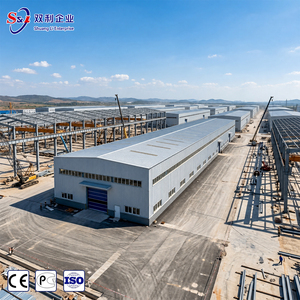
Established in 2001 in Pazhou, Haizhu District, Guangzhou—directly adjacent to the world-renowned China Import and Export Fair (Canton Fair) Complex—Guangzhou Heda Shelves Co., Ltd. has spent over two decades engineering, fabricating, and exporting premium-grade industrial storage systems. With an expansive production campus exceeding 30,000 square meters, over 300 skilled technical personnel, and a monthly structural processing capacity surpassing 3,000 metric tons, we have delivered more than 5,000 successful projects to over 130 countries worldwide.
We source certified prime cold-rolled steel billets from state-owned mills, guaranteeing minimum yield strengths of 235 MPa and superior weld integrity free of slag or surface porosity.
Equipped with an automated multi-stage pre-treatment, phosphating, and electrostatic powder application line that delivers an 80–120 micron cured finish resistant to abrasion, salt spray, and extreme humidity.
Our dedicated bilingual structural engineering department reviews architectural layouts, computes dead and live load envelopes, and delivers full 2D AutoCAD and 3D Revit renderings within 8 business hours.
Every component is pre-engineered for precision modular knock-down assembly, maximizing 40ft High Cube container volumetric stuffing efficiency and driving ocean freight expenditures down by up to 25%.
Tailored structural bracing schemes, widened high-load footplates, and seismic expansion anchors compliant with IBC and AS4084 standards for installation across earthquake-prone regions globally.
Visit our showroom and heavy automated workshops during your trip to the Canton Fair, or schedule a third-party audit through SGS, BV, or TÜV Rheinland prior to container sealing.
Submit your warehouse AutoCAD floor plan, ceiling clear heights, and pallet specifications. Our senior structural export engineers will calculate beam deflections, lane gradients, and container loading schedules within 8 hours.