HEDAHeavy Duty Racking
 English
 Español
EnglishEspañolEngineered with prime cold-rolled Q235B steel, modular upright punch configurations, and precision electrostatic powder-coat finishes for industrial distribution hubs.
Evaluate structural performance, floor footprint utilization, and handling equipment compatibility before procurement.
| Racking Architecture | Space Utilization | Pallet Selectivity | Handling Machinery | Unit Load Range | Ideal Application |
|---|---|---|---|---|---|
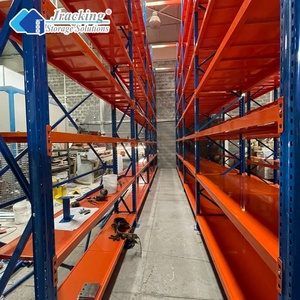
| Selective Pallet Racks | 40% – 50% Floor Density | 100% Immediate Access | Standard Counterbalance / Reach | 1,000 – 4,500 kg / level | FMCG, Multi-SKU Distribution, 3PL Warehouses |
| Very Narrow Aisle (VNA) | 65% – 75% Floor Density | 100% Immediate Access | Specialized VNA Turret / Guide Wire | 1,000 – 3,000 kg / level | High-Ceiling Logistic Hubs, Expensive Real Estate |
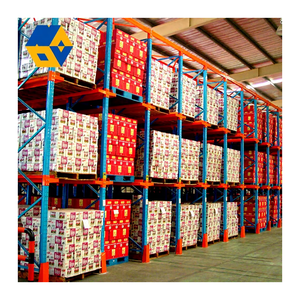
| Drive-in / Drive-Thru | 70% – 85% Floor Density | FILO / Low Selectivity | Standard Counterbalance Forklifts | 1,000 – 2,000 kg / pallet | Cold Storage, Homogeneous Bulk Goods, Seasonal Buffer |
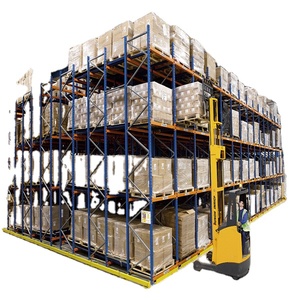
| Radio Shuttle Systems | 80% – 90% Floor Density | High Automated FIFO / FILO | Shuttle Cart + Forklift Interface | 500 – 2,000 kg / pallet | Deep-Freeze Cold Rooms, Food & Beverage Mega-Hubs |
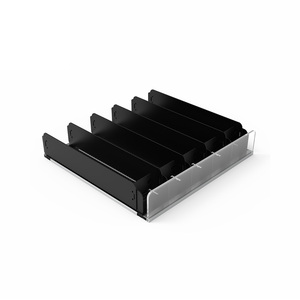
| Push Back (Telescopic Cart) | 65% – 75% Floor Density | FILO (2–6 Pallets Deep) | Standard Reach / Counterbalance | 1,000 – 1,500 kg / pallet | Cross-Docking Staging, Medium SKU Turnover |
| Heavy Duty Mezzanine Floor | Up to 100% Overhead Expansion | Multi-Tier Manual / Pallet Jack | Freight Elevators, Forklifts, Chutes | 500 – 1,500 kg / m² | E-commerce Picking, Spare Parts, Integrated Retail |
Operating from Pazhou, Guangzhou adjacent to the Canton Fair Complex since 2001, we deliver complete turn-key manufacturing backed by strict structural compliance.
Founded in 2001, Guangzhou Heda Shelves Co., Ltd. has delivered over 5,000 completed warehousing projects across 100+ nations. From single distribution depots to 30,000 m² automated hubs, our institutional engineering knowledge mitigates seismic, load-bearing, and operational risks.
We source heavy-gauge certified Q235B (and Q355B for high-stress zones) hot and cold-rolled steel coils from top-tier mills. Materials undergo automated continuous roll-forming with consistent tensile strength, yielding reliable structural deflection ratios strictly below L/200.
Our automated surface treatment pipeline includes 5-stage acid wash, phosphating passivation, and electrostatic powder coating. Cured at 200°C, the finish eliminates welding slag, resists micro-cracking in -35°C cold storage, and meets ISO 9227 salt spray standards.
All beams, upright columns, and bracing panels are engineered for complete flat-pack knock-down shipment. Custom containerization plans allow us to fill 40ft HQ containers with zero dead volume, protecting parts from ocean transit friction while reducing client freight costs by up to 30%.
Our dedicated bilingual structural engineering department reviews architectural layouts, floor slab data, and pallet parameters within 8 hours. We deliver complete CAD drawings, static load calculations, and photorealistic 3D structural previews before factory cutting begins.
We provide full tooling flexibility: 50mm, 75mm, 76.2mm (3-inch) pitch punching, teardrop systems for North American retrofits, and European box beam connectors. OEM branding, custom RAL powder shades, and custom roll-formed thicknesses are standard factory procedures.
Anticipate regulatory changes, robotic warehouse interfacing, and sustainable metallurgy when designing long-term storage investments.
Procurement directors are shifting away from static manual selective racking toward semi-automated and automated hybrid architectures. Warehouses are increasingly designed with tighter tolerances (FEM 9.831 / 9.832 standards) to accommodate Autonomous Mobile Robots (AMRs), Automated Guided Vehicles (AGVs), and high-speed radio shuttle carts.
Modern procurement contracts require roll-forming precision within ±0.5mm across 12-meter upright runs to prevent robot navigation misalignment. Future-proof facilities invest in modular beam connector designs that allow boltless conversion from manual forklift access to radio-shuttle high-density lanes without replacing primary structural frames.
Global climate patterns and updated building codes in South America (Chile, Ecuador, Peru), Oceania, and the Mediterranean have made dynamic seismic calculations mandatory. Pallet racking is no longer purchased as mere "shelving," but as critical civil equipment subject to severe horizontal earthquake shear stresses.
Key procurement specifications now demand expanded baseplate thicknesses (10mm to 16mm), double-anchor sleeve systems, specialized frame back-to-back portal bracing, and finite element analysis (FEA) validating frame response under elastic spectrum accelerations up to 0.4g.
Driven by rapid biomedical storage and frozen food expansion, cold-chain warehousing has become the fastest-growing sector in logistics procurement. Operating at temperatures between -25°C and -35°C presents severe risks of cold-embrittlement in standard carbon steel, which can lead to catastrophic brittle fracture.
Leading buyers specify high-impact notch toughness steels (such as Q235D/E or European S355JR with tested Charpy V-notch values at sub-zero temperatures) and heavy-duty pre-galvanized or hot-dip galvanized components. Furthermore, because cooling cubic space is costly, high-density Drive-In and Automated Shuttle systems are replacing wide-aisle layouts to minimize refrigeration electricity consumption by up to 45%.
Corporate sustainability mandates (ESG) are driving supply chain directors to scrutinize tier-1 factories. Racking fabrication requires considerable energy during high-tonnage coil slit roll-forming and powder curing. Sourcing teams prioritize factories utilizing closed-loop water recovery during acid pickling, 100% recyclable polyester powders with zero volatile organic compounds (VOCs), and robotic laser nesting lines that minimize steel scrap rates below 2.5%.
Furthermore, life-cycle durability is replacing low upfront purchase price as the primary KPI; durable multi-stage epoxy coats prevent oxidation, eliminating the expensive operational downtime associated with replacing corroded uprights in humid tropical ports.
Explore documented project deliveries designed, fabricated, and exported from our Guangzhou facilities.
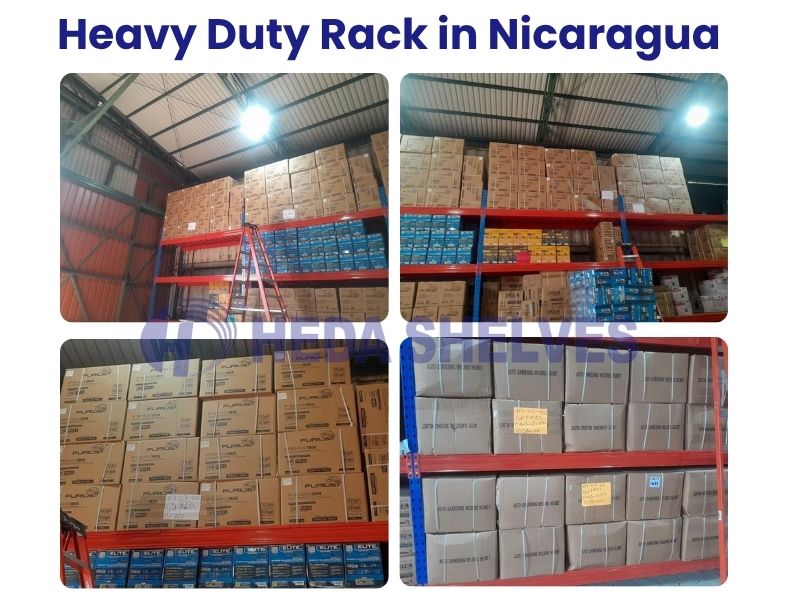
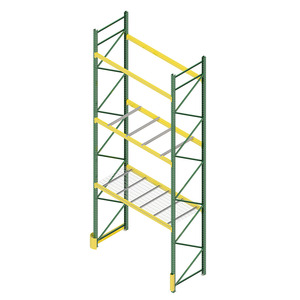
Engineered for high-SKU accessibility, featuring reinforced wire decking panels and heavy upright impact column guards.
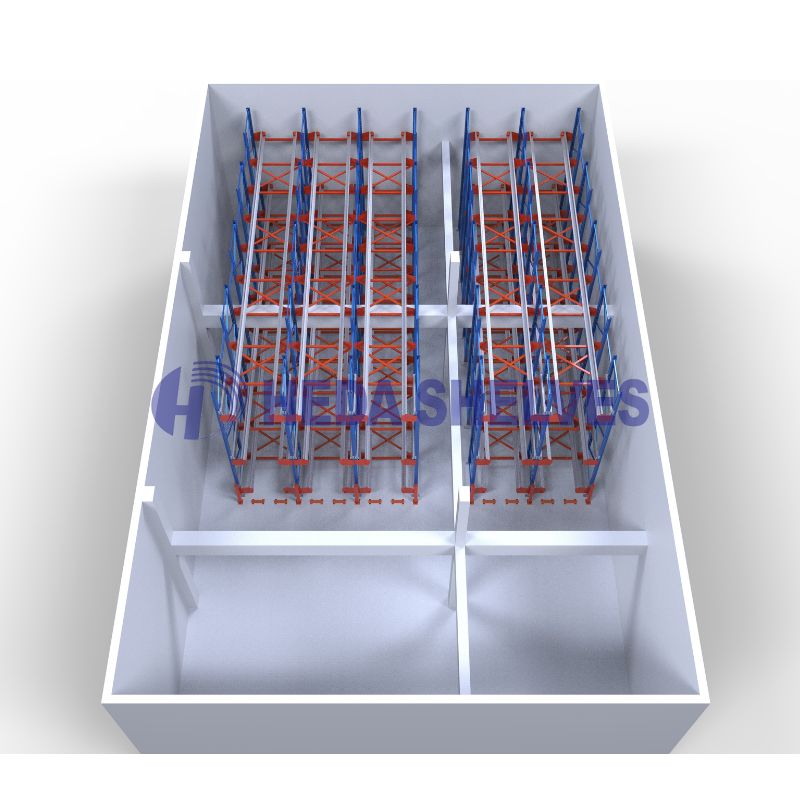
High-density automated cold-room lanes calculated in 3D to optimize sub-zero cubic volume and reduce compressor energy loads.
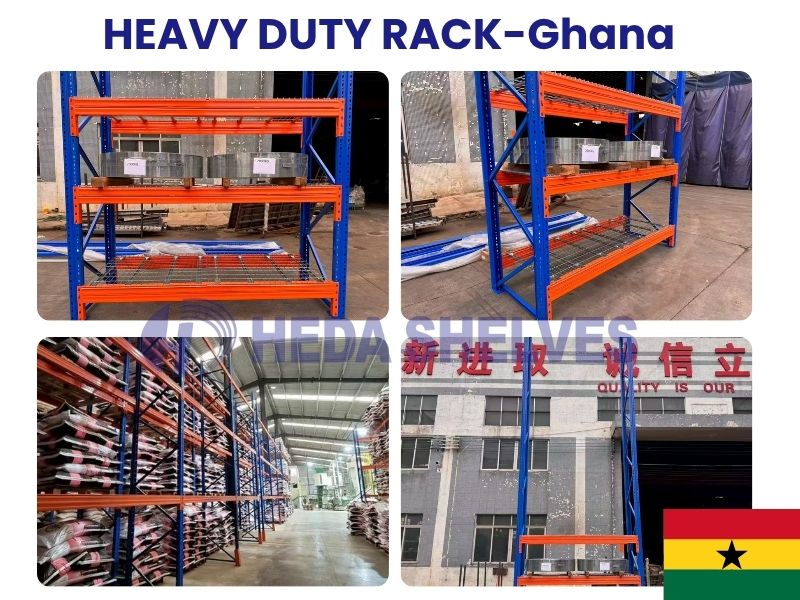
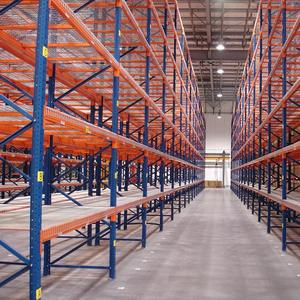
8.5-meter high-bay system load-tested with double safety factors, built with 120mm wide Omega upright columns.
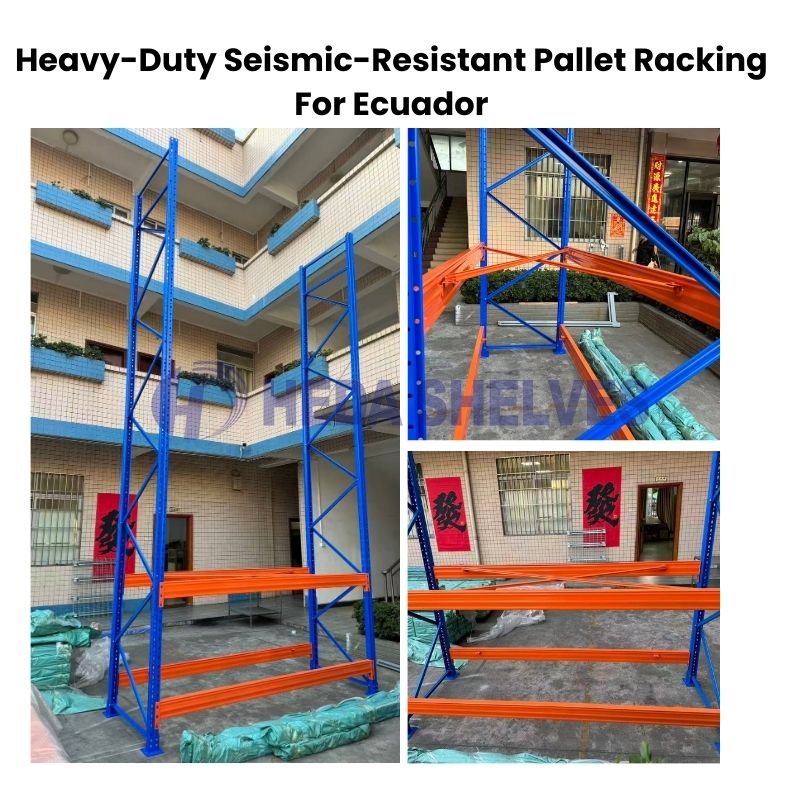
Custom 16mm anchor baseplates and mid-span X-bracing configured specifically for Pacific Rim seismic zone requirements.
Critical engineering answers regarding structural deflection, international freight packing, load verification, and seismic standards.
In accordance with global structural standards (European FEM 10.2.02 and American ANSI/RMI MH16.1), the maximum permissible vertical deflection of a pallet rack beam under design load is L/200 (where L is the clear span distance between upright columns). For example, on a standard 2,700mm beam designed for two 1,000 kg pallets, the mid-span deflection must not exceed 13.5mm.
For automated installations (such as Radio Shuttle or ASRS systems), Heda designs to an even stricter threshold of L/300 to guarantee flawless sensor alignment and robotic cart docking.
For seismic-rated projects (such as our delivered installations across Ecuador, Chile, New Zealand, and Japan), we conduct Finite Element Analysis (FEA) factoring in local building codes (UBC, IBC, or Eurocode 8). Calculations account for the building's fundamental vibration period, ground acceleration factors, soil foundation coefficients, and seismic mass (typically 80% to 100% of the rated pallet weight).
Physical structural enhancements include upgrading upright steel thickness, replacing single anchors with dual heavy-duty expansion sleeves, adding horizontal and vertical top portal ties, and installing heavy-gauge back X-bracing to distribute lateral forces safely to the reinforced concrete floor slab.
Yes. As a premier OEM/ODM manufacturer, we maintain CNC tooling sets for the world’s most common punching styles. While our standard export line uses the versatile 50mm and 75mm European pitch, we regularly fabricate the 76.2mm (3-inch) pitch prevalent in Commonwealth markets, as well as teardrop punch styles required by North American operators.
During the RFQ phase, you can supply a physical sample or technical 2D drawing of your existing column and connector. Our engineers will match the hook configuration, steel gauge, and lock-pin positioning to ensure 100% backward compatibility.
For standard ambient warehouses, we utilize an automated multi-stage pre-treatment followed by thermosetting polyester powder coating baked at 200°C. However, in cold storage facilities (-18°C to -35°C), thermal contraction and humidity changes during defrost cycles can cause micro-fissures in standard coatings.
For cold-room projects, we offer two solutions: (1) Low-temperature flexible modified epoxy-polyester powder coats that remain elastic at sub-zero temperatures, or (2) Hot-Dip Galvanizing (HDG) to ISO 1461 specifications, where the structural steel is submerged in molten zinc at 450°C, providing a permanent 65–85 μm metallurgical barrier that prevents rust, flaking, or delamination even under heavy condensation.
International shipping efficiency is central to our OEM service. Upright frames are delivered knocked-down (frames assembled on-site via high-tensile Grade 8.8 bolts) or welded according to customer preference. Knock-down packing reduces ocean freight volume by up to 38% compared to pre-welded uprights.
Step beams are bundled in uniform steel-strapped packs with protective cardboard edging and heavy corrugated wrap. All painted contact points are separated by non-abrasive foam strips to eliminate transit vibration friction. Heavy baseplates, row spacers, and hardware bolts are packaged in solid wooden crates or reinforced metal cages with dedicated forklift skids for rapid container unloading.
To deliver an actionable engineering drawing and quotation within 8 hours, our structural team requires five key data points:
1. Warehouse Architectural Layout: Clear internal height, column locations, and dock door placements.
2. Pallet Load Specifications: Length, width, overall height (including cargo), and maximum gross weight per pallet.
3. Material Handling Equipment: Forklift model, maximum lifting height, turning radius, and aisle operating clearance.
4. Operating Environment: Ambient temperature, humidity, or cold-room parameters.
5. Regional Seismic / Slab Data: Concrete slab thickness, compressive strength (e.g., 25–30 MPa), and local seismic acceleration values.
Whether you require standard selective pallet racks, seismic-rated cold chain architecture, or a completely custom OEM manufacturing run, Guangzhou Heda Shelves Co., Ltd. delivers factory-direct pricing, certified Q235B structural integrity, and layout designs within 8 hours.
Inquire Now