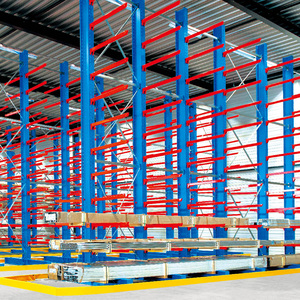
 Heavy-Duty Cantilever
HEDAHeavy Duty Racking
 English
 Español
EnglishEspañolEngineered to FEM 10.2.02, EN 15512, and RMI standards. Every racking solution is fabricated from high-grade cold-rolled structural steel, optimized for heavy load tolerances, high-bay automated material handling, and maximum vertical volumetric efficiency.
Heavy-Duty Cantilever
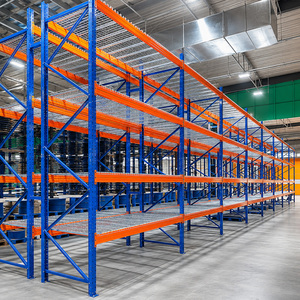 Automotive Hub Racks
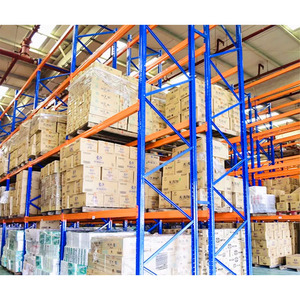 High Capacity System
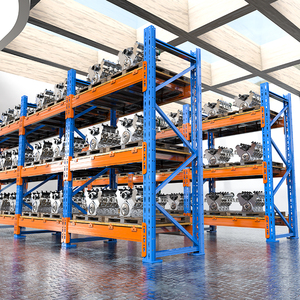 Cold-Store Automated
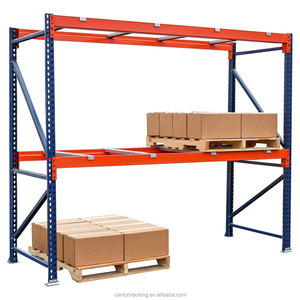 Modular Steel Shelf
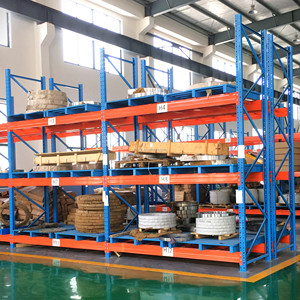 Post Stacking Rack
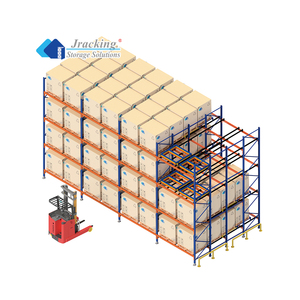 Dynamic Push-Back
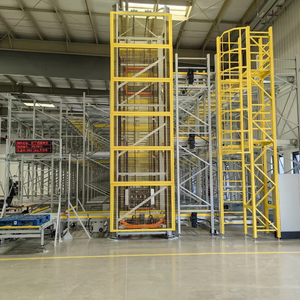 Intelligent Selective
In the era of hyper-dense logistics and industrial land scarcity, the Heavy-Duty Four-Way Radio Shuttle Racking System (4-Way ASRS) represents the pinnacle of intralogistics automation. Unlike traditional two-way shuttles constrained strictly to single aisle depth, or heavy stacker cranes requiring massive structural clearances and single-point-of-failure liabilities, the four-way shuttle system unlocks genuine three-dimensional coordinate movement (X, Y, and Z axes). Operating on a matrix of ultra-precise cold-rolled bidirectional rails, the autonomous shuttle vehicle executes both longitudinal pallet conveyance and lateral lane switching under deterministic Warehouse Control System (WCS) algorithms.
As a premier direct manufacturer established in 2001 in Guangzhou, China, our heavy-duty engineering philosophy is rooted in material durability, finite element load simulation (FEA), and strict adherence to FEM 10.2.02 (European Design Code for Pallet Racking) and ANSI/RMI MH16.1. High-density four-way shuttle racking demands mechanical tolerances far tighter than conventional selective shelving. The cumulative deviation of running rail straightness must remain within ±1.0 mm per 10 meters, while floor leveling, column perpendicularity, and tie-back deflection under thermal variance must withstand dynamic acceleration vectors up to 1.5 m/s² with payloads surpassing 1,500 kg per pallet tier.
| System Architecture Parameter | Standard Selective Racking | Drive-In / Push-Back Racking | 2-Way Radio Shuttle System | HEDA Heavy-Duty 4-Way Shuttle ASRS |
|---|---|---|---|---|
| Volumetric Space Utilization | 35% – 42% | 55% – 65% | 70% – 78% | 85% – 92% (Maximum Vertical Density) |
| Kinematic Mobility & Axes | Manual Forklift (Z/X) | Manual Forklift inside bays | Single-track Longitudinal (X) | Omnidirectional 3D Matrix (X, Y, Z Lifter) |
| Throughput Dynamic Scalability | Bound to forklift fleet | Extremely low; bottleneck prone | Bound to 1 shuttle per aisle | Dynamic fleet scaling (Add shuttles freely) |
| Structural Steel Specification | Standard Hot/Cold Q235B | Q235B Standard Uprights | Precision Rails, Q235B Beam | Precision Cold-Rolled Q235B/Q355 + CNC Tracks |
| Operating Temperature Envelope | Ambient to Cold (+40°C to -10°C) | Ambient to Cold (+40°C to -15°C) | Ambient to Cold (+35°C to -20°C) | Deep Freeze to High Heat (-30°C to +50°C) |
| Single Point of Failure (SPOF) | Low (Forklift dependent) | Low (Forklift dependent) | Moderate (Lane blocked if broken) | Zero SPOF (Mutual bypass & vehicle substitution) |
A turnkey heavy-duty 4-way shuttle infrastructure comprises four interdependent structural sub-assemblies. Deficiencies in any single component compromise system MTBF (Mean Time Between Failures) and pallet positioning repeatability:
Fabricated through multi-stand continuous cold-roll forming, the rail acts simultaneously as the shuttle load-bearing track and structural lateral beam. Dual-axis running surfaces feature anti-slip, high-wear treatments, ensuring sub-millimeter positional encoder calibration and low vibration.
Integrated at rack perimeters, continuous servo-driven reciprocating lifts transfer both loaded pallets and four-way shuttle vehicles between vertical storage tiers. Equipped with counterweights, pneumatic safety brakes, and optical laser positioning, vertical speeds reach up to 1.5 m/s.
The neural core of the hardware matrix. The software calculates dynamic optimal route matrices, real-time deadlock mitigation, collision-free crossing paths, and battery state-of-charge (SoC) management with rapid automatic docking at integrated high-amperage supercapacitor charging stations.
Our senior warehouse design engineers analyze your floor CAD, pallet load profiles, and peak SKU cycles to deliver full 3D layouts within 8 hours.
Across European, North American, Middle Eastern, and Southeast Asian industrial corridors, industrial logistics procurement is transitioning rapidly from labor-heavy manual reach-truck facilities toward modular, lights-out automated warehousing. Procurement directors evaluating tier-one racking suppliers are aligning specifications with key technological shifts:
Historical automated systems (such as miniloads and stacker cranes) demanded massive front-loaded capital investments sized to handle peak year-10 volumes. In contrast, modern procurement strategies specify heavy-duty 4-way racking built for full physical capacity upfront, while purchasing only the baseline number of shuttle vehicles needed for initial years. As operational volume surges, additional shuttles are commissioned seamlessly without structural disruption.
Thermal energy in cold storage accounts for up to 65% of ongoing facility OpEx. Because four-way shuttle racking eliminates forklift access aisles and reduces required lighting and thermal dissipation, cold-store footprints can be compressed by 40%. Buyers now mandate low-temperature certified steel alloys (such as Q355D/E) that prevent cold-embrittlement at -25°C to -30°C.
Forward-thinking supply chain executives refuse proprietary vendor lock-in. Sourcing criteria now demand standard RESTful APIs, OPC UA industrial protocols, and MQTT telemetry so the four-way shuttle field hardware can interface natively with SAP, Manhattan Associates, Blue Yonder, or proprietary customer ERP/WMS platforms.
Headquartered in Guangzhou, adjacent to the Canton Fair Complex, Guangzhou Heda Shelves Co., Ltd. has delivered heavy-duty engineering solutions to more than 5,000 corporate projects worldwide.
Founded in 2001 with over two decades of dedicated R&D, precision cold-forming, and structural racking engineering expertise.
Monthly structural throughput exceeding 3,000 tons, supported by 300+ certified technicians and specialized automated roll-forming lines.
Exclusively cold-rolled prime structural steel with high yield strength, tested against rigorous non-destructive ultrasonic weld audits.
Upgraded electrostatic automated powder coating lines delivering a smooth, slag-free, chip-resistant finish for extended service lifespans.
Dedicated export engineering teams ready to review structural specs, 3D building drawings, and return preliminary engineering layouts within 8 hours.
All structural components feature precision knock-down modular designs that protect parts in international transit, maximize standard 40ft high-cube ocean container fill-rates, and significantly reduce overseas freight expenditures. For seismic-active regions across Oceania, South America, and Japan, HEDA engineers deploy customized structural floor anchorages, heavy-gauge baseplates, and high-ductility vertical cross-bracing frameworks.
Consult an Application EngineerComprehensive engineering and procurement clarity addressing load limitations, floor flatness tolerances, cold-store durability, and lifecycle reliability.
From initial warehouse cad optimization to containerized global dispatch, HEDA delivers factory-direct engineering certainty.