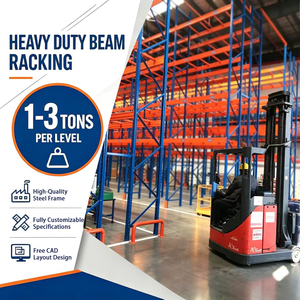
Up to 3000KG/Layer
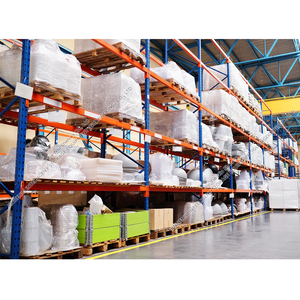
Heavy Duty Selective Pallet Racking Adjustable Beam Level 3000KG
- Direct 100% SKU Accessibility
- Q235B Cold-Rolled Structural Steel
- Adaptable to Stepped Tire Beams
 English
 Español
Precision-engineered, cold-rolled certified steel racking configurations suited for passenger car radial (PCR), truck and bus radial (TBR), off-the-road (OTR) tires, and automotive components.
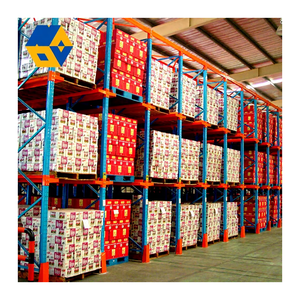
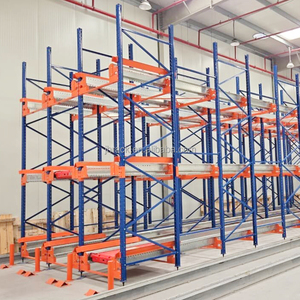
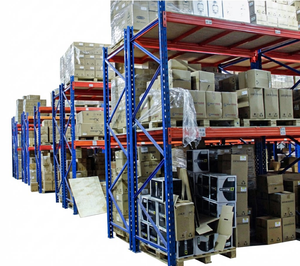
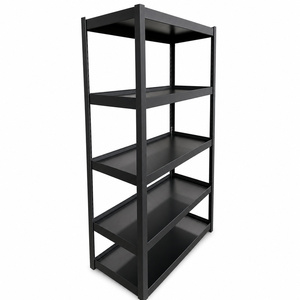
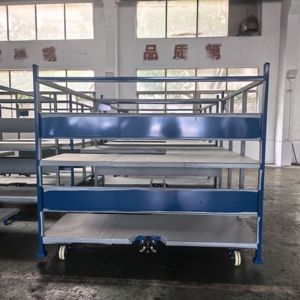
Storing tires presents fundamentally different engineering challenges compared to standard boxed or palletized loads. Tires represent high-density, elastic rubber rings with specialized structural behaviors. When placed on flat wood or steel pallets, tires are prone to irreversible tread flat-spotting, sidewall compression deformation, and bead distortion if stacked excessively high without horizontal support.
A certified Heavy Duty Tire Storage Racking System solves this via specialized structural geometries: step-down barrel beams, cylindrical cradle bars, and inclined angle supports. Rather than relying on planar decks, specialized tire beams hold tires vertically on their treads along two parallel tubular or stepped rails. This configuration transfers load stresses tangentially through the circumferential tread rather than the sidewall, ensuring structural integrity throughout extended storage periods.
Selecting the optimal tire storage matrix requires warehouse directors to evaluate the exact trade-off between pick speed (selectivity) and volumetric density. The table below illustrates the structural parameters of major systems configured for automotive logistics:
| Racking Architecture | Storage Method | Selectivity | Aisle Space Req. | Target Tire Application |
|---|---|---|---|---|
| Selective Tire Racks | Vertical Tread on Beams | 100% Immediate | 3.0m - 3.5m | Fast-moving PCR, mixed retail distribution, service centers |
| High-Bay Drive-In Racks | Palletized / Stillage Laced | 20% - 30% (FILO) | Aisle-less compact | High-volume seasonal tires, bulk OEM supply chains |
| Automated Radio Shuttle | Tire Stillages on Rails | High (Automated FIFO/LIFO) | Transfer aisle only | Regional consolidation hubs, cold/damp tire buffers |
| Modular Stacking Stillages | Vertical or Barrel Laced | Stack-dependent | Flexible floor space | Dynamic 3PLs, cross-docking, plant-to-plant transfer |
Over the next decade, geopolitical supply disruptions, warehousing real estate inflation, and stricter carbon audits are fundamentally altering international procurement strategies. Global tire distributors, automotive OEMs, and 3PL contractors are prioritizing three decisive advancements:
Rising ocean freight costs demand maximum container load optimization. Racking systems engineered with modular, boltless knock-down frames enable up to 40% higher cubic fill in standard 40ft High Cube containers, minimizing land-land transport costs.
Manual tire handling causes elevated occupational strain and ergonomic fatigue. Modern warehouses are migrating to Automated Storage and Retrieval Systems (AS/RS) paired with specialized autonomous mobile robots (AMRs) capable of picking stillages without operator intervention.
Procurement teams now mandate environmental and metallurgical transparency. High-tensile Q235B cold-rolled profiles treated with lead-free, zero-VOC electrostatic epoxy powder coating significantly reduce environmental footprints while delivering supreme anti-corrosion resilience.
The manufacturing of heavy-duty tire storage racks is transitioning from standard metal fabrication to robotic precision engineering. Leading automated rolling lines now produce continuous punched upright columns featuring micro-tolerance connector slots (50mm or 75mm pitch). This allows warehouse operators to reconfigure beam tiers dynamically as tire portfolio diameters shift throughout season cycles.
Furthermore, specialized finite element analysis (FEA) software allows suppliers to model load deflections, seismic shear forces, and wind loads before rolling steel. Advanced double-deep and cantilever configurations for large agricultural and mining OTR (Off-the-Road) tires are now manufactured with custom forged hinge pins and safety lock pins to entirely prevent accidental beam dislodgement under intense forklift impact.
Operating from Guangzhou with over 20 years of structural engineering excellence, delivering verified reliability for demanding automotive and industrial applications.
Over two decades of proven experience designing, manufacturing, and installing storage solutions across 5,000+ completed projects worldwide.
From selective, shuttle, cantilever, and mezzanine systems to customized automotive stillages and retail displays produced in-house.
Height, depth, beam span, weight rating, and powder-coat colors precisely adapted to specific client tire diameter matrices and building layouts.
Certified Q235B cold-rolled steel, robotic welding, smooth slag-free powder coating, and pre-shipment structural load testing up to 4,500 kg.
Direct technical answers from our senior racking structural engineering division.
Traditional flat pallet decks concentrate the full weight of a vertical tire on a single narrow line of the tread, causing flat-spotting. Our specialized tire racks utilize dual curved or stepped support beams that contact the tire along two symmetrical tangential points. This balances internal belt tension, prevents bead deformation, and allows air circulation around the rubber compound.
While passenger car radial (PCR) tires can use systems rated from 800 to 1,500 kg per level, commercial truck/bus (TBR) and heavy agricultural or mining (OTR) tires require heavy-duty upright frames and stepped box beams engineered to support between 2,500 kg and 4,500 kg per beam level. All systems undergo FEA calculation to guarantee minimum 1.5 safety factors under full dead loads.
Yes. Our engineering division produces detailed 2D CAD architectural plans and photorealistic 3D layout renderings prior to manufacturing. If your warehouse is located in a seismically active geographic zone, our engineers integrate expanded footplates, heavy-gauge floor anchors, and reinforced X-cross bracing according to regional building codes.
Production typically requires 15 to 25 working days depending on total project tonnage. All rack frames and beams are shipped in knock-down (KD) bundles wrapped in protective bubble film, corrugated corner protectors, and steel banding. This knock-down methodology ensures components remain unmarred while maximizing container space utilization.
Static selective racks are permanently anchored to the concrete foundation and offer exceptional height utilization up to 12 meters. Conversely, folding metal stacking stillages (post pallets) allow dynamic 4-to-5-tier vertical stacking when loaded, but can be collapsed down to 25% of their height when empty, making them the standard choice for 3PL providers with seasonal tire fluctuations.
Our dedicated export engineering team operates across international time zones and guarantees a comprehensive response, technical feedback, or customized system quotation within 8 hours. Simply provide warehouse clear height, building column matrices, and target tire dimensions.
Connect directly with our senior racking engineering specialists. We provide complimentary facility layout design, load-bearing calculations, and factory-direct project pricing within 8 hours.