HEDAHeavy Duty Racking
 English
 Español
EnglishEspañolPrecision cold-rolled structural storage engineered to American RMI design philosophies and optimized for deep-reach pantograph reach trucks.
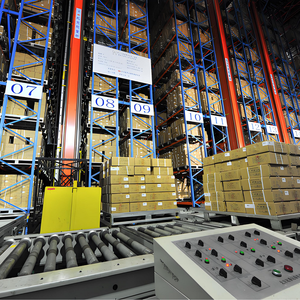
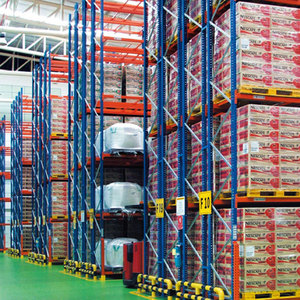
Navigating the geometric, mechanical, and logistical equilibrium between Selective Racking and Drive-In density.
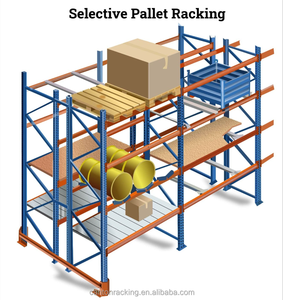
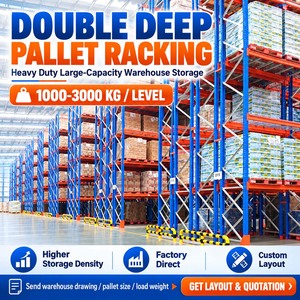
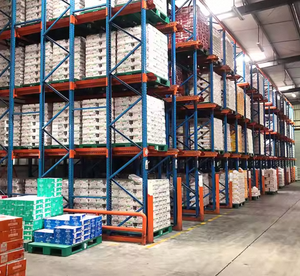
In logistics real estate markets characterized by acute spatial compression and soaring industrial rents—such as the Greater New York Metropolitan Area, Northern New Jersey, and the Meadowlands Corridor—traditional selective racking setups with 12-foot wide aisles dedicate over 60% of total footprint strictly to forklift transit. A Double Deep Racking System re-engineers this mathematical dynamic by storing pallets two positions deep from a single aisle access face. This architecture creates a back-to-back layout comprising 4-deep pallet arrays between operative aisles, eliminating 50% of the interior aisles typically demanded by single selective configurations.
Manufactured using high-tensile Q235B cold-rolled steel and compliant with strict ANSI/RMI MH16.1 specifications, our double deep racks strike an optimal compromise between high volumetric storage density (achieving up to 65% warehouse cube utilization) and pallet selectivity (50% direct selectivity on initial picking runs). The operational principle is rooted in a FILO (First-In, Last-Out) dispatch sequencing per pair of storage cells, which proves uniquely viable for facilities that stock homogeneous SKUs in 2, 4, or multi-pallet batches, such as dry goods distributors, beverage cross-docks, pharmaceutical buffer caches, and refrigerated wholesale walk-in freezers.
| Evaluation Metric | Standard Selective Racking | Double Deep Racking (HEDA Spec) | Drive-In Racking System | Radio Shuttle Pallet Racking |
|---|---|---|---|---|
| Cube Volume Density | Baseline (35% - 40%) | High (55% - 65%) | Very High (65% - 75%) | Maximum (75% - 85%) |
| Immediate Pallet Selectivity | 100% Direct Access | 50% Direct Access | Low (< 15% FILO/LIFO) | Lane Dependent (FIFO/LIFO) |
| Required Material Handling Equipment | Standard Counterbalance / Reach Truck | Pantograph Reach Truck / Deep-Reach Forklift | Narrow Counterbalance Truck | Standard Forklift + Automated Shuttle |
| Aisle Footprint Consumption | High (Aisle per double rack) | Reduced (Aisle per quad rack) | Minimal (Drive-in bays only) | Extremely Compact Aisle Array |
| Upfront CAPEX per Pallet Position | Low ($) | Moderate-Low ($$) - Exceptional ROI | Moderate ($$) | High ($$$$ - Automation Premium) |
| Seismic & Impact Redundancy | Standard Anchor & Bracing | Reinforced Lower Posts + Heavy Pallet Guide Rails | Prone to Bay Impact | Heavy-Duty Guided Channel Rails |
By pairing structural roll-formed upright columns with heavy-gauge horizontal step beams and dual guide rails, our double deep racks mitigate mast sway and assist forklift operators when positioning heavy pallets up to 30 feet in elevation. The result is minimized rack impact risks, accelerated cycle times, and an optimal capital outlay per square foot of warehouse floor space.
Engineered specifically to solve the high operating costs, vertical restrictions, and operational constraints of the New York-New Jersey shipping territory.
Warehousing in Long Island City, Brooklyn (Sunset Park/Red Hook), and the South Bronx (Hunts Point) is subject to premium rental rates exceeding $28–$40/sq. ft. net. Double deep installations condense FMCG and e-commerce inventory, granting maximum bulk pallet capacity inside urban infill facilities with narrow floor plans.
Operating industrial freezers in the NYC culinary distribution circuit incurs immense refrigeration kilowatt expenses. Our hot-dip galvanized and electrostatically powder-coated double deep racking reduces unused aisle volume, enabling cold storage operators in Maspeth and Queens to cool dense product mass rather than dead air space.
Freight arriving through Port Newark Container Terminal (PNCT) into 3PL staging warehouses in Elizabeth, Jersey City, and Secaucus requires staging for 2-to-4 pallet identical manifests. Double deep systems handle pallet pairs straight out of marine containers with high operational dispatch velocities.
Serving pharmaceutical distribution centers located along the New Jersey Life Sciences Corridor and Westchester County, our racks deliver batch-lot quarantine segregation with secure bottom load rails, ensuring lot-traceable compliance and zero package crushing.
Heavy pallet loads across Long Island (Suffolk and Nassau Counties) demanding 3,000–4,500 kg per beam level for stone, fixtures, and bulk building supplies exploit our heavy-gauge roll-formed box beams, maximizing vertical clear height under 32-foot ceilings.
From Newburgh and Stewart Airport down through the Hudson Valley, massive regional distribution centers employ double deep layouts to service both New York State and New England metropolitan centers, lowering the overall cost-per-pallet position.
Why leading North American warehouse developers are replacing traditional selective racks with high-density steel configurations.
With land availability at historical lows within 15 miles of Manhattan, real estate holding costs mandate vertical intensification. Warehouses are constrained to convert horizontal footprints into multi-level, high-capacity double deep storage racking.
Major lift truck manufacturers (Raymond, Crown, Toyota) have introduced ergonomic, laser-guided pantograph deep-reach trucks with high battery efficiencies, lowering the barrier of entry for operating double deep setups in narrow aisles.
New York State Uniform Fire Prevention and Building Code as well as NFPA 13 in-rack sprinkler mandates require engineered rack flue spaces (longitudinal and transverse). Our factory designs integrate exact beam stops and flue preservation clips to pass municipal inspection smoothly.
With over 20 years of precision manufacturing, Guangzhou Heda Shelves Co., Ltd. delivers heavy-duty certified storage directly to North American job sites.
Established in 2001, executing 5,000+ completed commercial and industrial installations worldwide with complete structural documentation.
State-of-the-art automated roll forming, robotic welding, and automatic electrostatic powder-coating lines operating inside a modern facility.
Customizable upright profiles, beam lengths, beam connector pin-locks, seismic footings, guide rails, and high-visibility corporate color finishes.
Certified Q235B cold-rolled steel raw material verification, certified weld penetration tests, and load stress audits up to 4,500 kg per beam level.
Dedicated bilingual project engineers provide 2D/3D CAD warehouse layouts, load tables, and freight container loading optimization within 8 hours.
Clear, engineer-backed answers addressing structural calculations, lift requirements, fire regulations, and lead times.