Mezzanine & High-Density
 English
 Español
Engineered from premium Q235B cold-rolled structural steel, load-rated up to 4,500 kg per level, and tailored for Massachusetts distribution hubs.
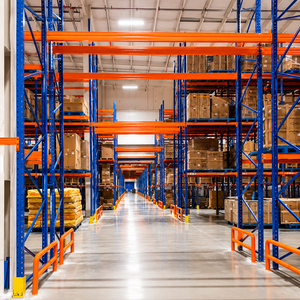
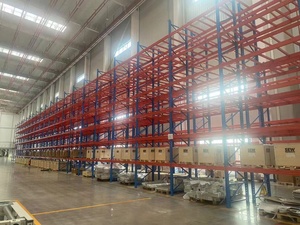
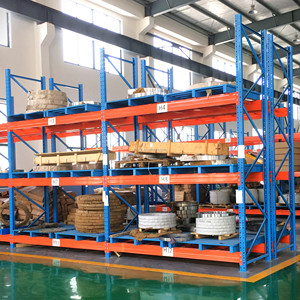
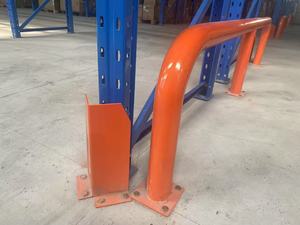
Understanding cart kinematics, inclined rail geometry, seismic design criteria, and operational ergonomics in high-cost commercial real estate.
In the Greater Boston industrial sector—encompassing key warehousing clusters along the Route 128 inner ring (Waltham, Woburn, Braintree) and the I-495 outer logistics spine (Franklin, Marlborough, Tewksbury, Lawrence)—the cost per square foot for class-A and class-B industrial facilities remains among the highest on the US Eastern Seaboard. With triple-net (NNN) warehouse lease rates frequently topping $16 to $24 per square foot, supply chain directors face an unrelenting imperative: extract maximum cubic storage efficiency without sacrificing SKU selectivity or material handling velocity.
Push rack systems (commonly designated in the material handling industry as Push Back Pallet Racking) represent the premier high-density dynamic storage solution that bridges the structural gap between pure Selective Pallet Racks (100% selective, yet requiring 50% floor area for operational forklift aisles) and Drive-In Racking systems (high density, yet prone to rack collisions, slower forklift transit times, and restricted honeycomb SKU rotation). As experienced push rack manufacturers delivering global installations since 2001, our engineering department designs nested cart systems capable of staging 2, 3, 4, 5, and 6 pallets deep per storage lane while functioning under a Last-In, First-Out (LIFO) operational protocol.
A push rack system operates by mounting a series of inclined, telescoping nested steel carts on heavy-duty structural steel channel tracks. The system exploits gravitational dynamics: the structural steel rails are precision-pitched at a calibrated grade (typically 2.5% to 3.5%, depending on the unit pallet load mass, pallet bottom runner configuration, and cold storage thermal requirements). When a counterbalanced or reach forklift operator places the initial pallet onto the top nesting carriage, the system is primed. As the subsequent pallet is introduced, the forklift operator gently pushes the initial pallet backward along the incline, revealing the nested lower carriage underneath.
Unlike pallet flow rack systems (which rely on full-depth centrifugal brake rollers and require separate loading and retrieval aisles), push back racks operate entirely from a single front access aisle. This cuts required operating aisle space by 40% to 55% while maintaining distinct SKU accessibility at every vertical level and horizontal lane. Crucially, because lift trucks never enter the rack structure—in sharp contrast to drive-in rack configurations—upright impact frequency is reduced by over 80%, substantially diminishing structural maintenance expenditures and safeguarding warehouse personnel.
| Storage System Type | Space Utilization | SKU Selectivity | Forklift Damage Risk | Boston Facility Suitability | Average Pick Speed |
|---|---|---|---|---|---|
| Push Back Racking (HEDA Engineered) | High (Up to 85%) | Level-by-Level (LIFO) | Very Low (External Aisles Only) | Ideal for Cold Storage, Pharma, 3PL | Fast (15-25 Pallets/hr/Aisle) |
| Standard Selective Pallet Racks | Low (~40% - 50%) | 100% Selective | Moderate (Frequent Aisle Transit) | High Real Estate Cost Penalty | Standard (Single SKU Picking) |
| Drive-In Pallet Racks | High (~75% - 85%) | Strict Lane-by-Lane LIFO | High (Trucks Drive Inside Racks) | High Repair Cost / Safety Risk | Slow (Cautious Driver In-Bay Travel) |
| Pallet Flow (Gravity Roller) | Maximum (~85% - 90%) | Full FIFO Compliance | Low to Moderate | High Initial CapEx Investment | Moderate to Fast (Two Aisles Req.) |
Precision racking design for life sciences, sub-zero seafood distribution, grocery staging, and fast-turn 3PL fulfillment.
Boston leads the world in biotechnology and pharmaceutical innovation. Push back rack systems installed in Worcester, Waltham, and Framingham supply bases provide cleanroom-compatible, powder-coated cold storage for raw pharmaceutical reagents, packaging materials, and temperature-controlled finished drugs, preserving lot integrity with zero upright scraping.
Massachusetts seafood processing and frozen food wholesalers operating in Boston Marine Industrial Park (BMIP) and New Bedford harbor face astronomical refrigeration operating costs. Our 3-to-5 deep push rack systems condense chilled air cubic footprints by up to 55%, reducing utility overhead while using stainless bearings that operate smoothly at -25°C.
Regional distribution hubs serving Massachusetts, Rhode Island, and southern New Hampshire need immediate access to high-velocity fast-moving consumer goods (FMCG). Push racks allow dynamic buffering at dock areas, where full pallet drop-offs seamlessly replenish downstream carton-flow and pick-module zones.
From Taunton to Lawrence, advanced machinery fabricators store heavy dies, metal extrusions, and semi-finished component inventory. Structural I-beam uprights combined with push-back carriages engineered from Q235B steel handle dynamic pallet loads exceeding 3,000 lbs without deflection or carriage binding.
How strict Massachusetts building codes, municipal permitting, and premium floor costs drive high-density rack selection.
Industrial storage racks exceeding 8 feet in clear height are classified as structural systems under the 9th and 10th Editions of Massachusetts 780 CMR. Push rack manufacturers must calculate dynamic seismic coefficients (Ss and S1 values) matching local USGS hazard spectra, engineering oversized baseplates and high-shear seismic anchor bolts for municipal inspection approval.
Industrial land vacancy within 30 miles of Downtown Boston remains exceptionally tight, frequently hovering below 4%. Converting from conventional selective pallet storage to 4-deep push back systems allows operators to increase pallet storage capacity by 75% inside their current footprint, eliminating the need to lease secondary real estate or expand outer perimeters.
Dense pallet configurations in Massachusetts require close consultation with local Fire Marshals. Push back designs maintain designated transverse and longitudinal flue spaces (typically 3" to 6" open flue), allowing Early Suppression Fast Response (ESFR) ceiling sprinklers to penetrate water deep into internal racks without requiring expensive in-rack sprinkler pipe manifolds.
Direct manufacturer supply chain: zero broker markups, world-class precision robotic welding, and complete turnkey engineering support.
Founded in 2001, executing 5,000+ warehouse storage rack and mezzanine projects across 5 continents with zero structural safety compromises.
Fabricated solely with cold-rolled Q235B structural grade steel, delivering superior tensile resistance and ductile deflection integrity under dynamic push loading.
Full CAD layout designs, 3D structural simulations, and seismic calculation packets supplied prior to steel production, customized to forklift specifications.
Electrostatic automated powder-coating lines produce slag-free, chip-resistant finishes tailored for pharmaceutical hygienic codes and cold storage durability.
Our dedicated export engineering desk reviews architectural plans and RFPs within 8 hours, delivering turnkey pricing and container packaging optimization.
Critical answers regarding seismic testing, forklift compatibility, installation lead times, and cold room performance.
Collaborate with HEDA's engineering department. Send us your building architectural prints, clear ceiling heights, and pallet specifications. Receive a certified 3D CAD design and manufacturer-direct proposal within 8 hours.